
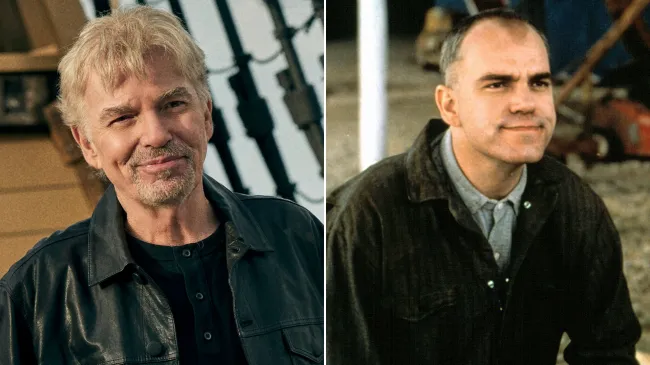
Billy Bob Thornton has plenty to be thankful for this Thanksgiving. The actor-director is headlining one of streaming’s biggest hits, Landman, which wrapped its second season on Paramount+ earlier this year and nabbed its first Actor Awards nominations, including for Best Drama Ensemble.. He and his band, The Boxmasters, then spent part of the summer opening for Pete Townshend and Roger Daltrey on The Who’s 2025 North American farewell tour — including a New Jersey gig where they played through an onstage power failure.
Heading into the holidays, Thornton lends his face and rich baritone to The Mayflower, a three-part Fox Nation docuseries that retells the story of the purported first Thanksgiving through the experiences of the European migrants that crossed the Atlantic aboard the titular ship and the Indigenous people who already populated these shores. Meanwhile, the day after Thanksgiving will mark a major milestone in his life and career as his Oscar-winning breakout film Sling Blade celebrates 30 years since its Nov. 27, 1996 theatrical release.

While Thornton can’t trace his own lineage back to the Mayflower, he considers himself a close student of American history, particularly the country’s colonial period leading up to the Revolutionary War. “Benjamin Franklin is my favorite historical figure, so I’ve definitely studied up on him,” the actor tells Gold Derby, while also joking that he’s “as dumb as a bag of hammers” when it comes to specific events like the landing of the Mayflower in what became Plymouth, Mass.
“This is a story where a lot of people don’t know what actually happened — and I was included in that,” Thornton says. “I was not any type of expert going into this, so my job was to host and say the wonderful words they wrote for me, and I learned the history as I went along. It made me want to go back and learn even more about what it.”
According to Thornton, The Mayflower‘s major teachable moment involves that first Thanksgiving dinner between the Pilgrims and nearly 90 men from the Wampanoag tribe. As shown in the series, the meal was considerably tenser than the version that the actor remembered learning about in elementary school. “Normally, the story we hear is that the Native Americans showed up and the Pilgrims offered them some turkey as a peace offering, but it wasn’t like that,” Thornton says. “It wasn’t exactly an invitation! It was more like the ultimate Thanksgiving party crashing.”

The Wampanoag attendees certainly had plenty of grievances to air, given the depletion of resources and spread of disease that had accompanied the Pilgrims’ arrival. The Mayflower accords equal time to the Indigenous perspective on this foundational American story, which is something that Thornton appreciated. Growing up, the actor believed he had some Choctaw heritage through his mother’s family, but a DNA test later revealed otherwise. “I’ll put it to you this way,” he says with a sly smile. “I’m a heck of a lot closer to the Pilgrims than I am to any native tribes — by a long shot.”
“But it’s rare that you get the other side of the story,” Thornton continues. “There was a lot of pain, suffering, and death for everyone involved at that time. When you think about what people went through on both sides of this, it should make us all have a little more reverence when we do sit down for Thanksgiving dinner now. When you’re a kid it’s all about the turkey, seeing your cousins, and playing in the backyard. But history is mattering again after a long dry spell where it didn’t seem to matter as much, and maybe people from my era were so set in their ways that they wanted to keep believing whatever history they came up with. I hope that young people watch the series and learned exactly what happened.”
Asked how he thinks he might have fared if he had been aboard the Mayflower, Thornton says his natural protectiveness would have thrust him into the role of diplomat. “If I had children on that ship where people were sleeping on top of each and there was so much sickness and misery, I would have been the problem-solver and protector of people,” he muses. “My head’s usually in the clouds, but when it comes to my family and my kids, I’m very protective and would want to be involved in any peacemaking process.”
Thornton’s powers of persuasion came in handy when he sought to turn his 1994 short Some Folks Call It a Sling Blade — based on his one-man show, Swine Before Pearls — into a feature film. Arriving in Hollywood at the tail end of the 1980s, just as the indie film movement was gaining serious steam, the aspiring director landed early scene-stealing roles in low-budget art-house hits like One False Move and Dead Man. Thornton raised the $1 million required to make Sling Blade and directed himself as Karl Childers, the developmentally disabled character at the center of the Southern Gothic-tinged drama.
What happened next was the kind of indie success story that could only happen in the ’90s. Acquired by Miramax for $10 million — a record at the time — Sling Blade grossed nearly $25 million at the domestic box office and transformed critical accolades into an awards run that saw its writer-director-star nominated for Best Actor and Best Adapted Screenplay at the 1997 Oscar ceremony, winning the latter category. That victory promptly vaulted Thornton onto Hollywood’s A-list for a three-decade run spanning from Armageddon to Landman.
Reflecting on Sling Blade three decades later, Thornton says that the most valuable part of the whole experience was solidifying his friendship with the late Robert Duvall. The Godfather star has a small, but memorable role in the film as Karl’s abusive father and Thornton can’t imagine anyone else playing the part.
“I knew him a little bit already, because we had the same agent,” he recalls. “I’d always wanted to meet him, but I also am a firm believer in not trying to meet somebody, because that’s going to happen when it’s supposed to happen.” Sure enough, Thornton eventually had his first meeting with Duvall on the set of the 1995 film, The Stars Fell on Henrietta, which shares some DNA with Landman. “It was also about oil guys, but I was the one in the greasy coveralls in that one,” the actor jokes.
That initial collaboration led to Thonrton and his writing partner, Tom Epperson, being invited to pen the 1996 drama, A Family Thing, for Duvall and James Earl Jones. That film was shot concurrently with Sling Blade in the Memphis area, and the first-time director called in a favor on the day he needed to shoot Karl’s scene with his father.
“It was my dream to get him to do it, and he came in on his day off,” Thornton recalls. “We had no trailers or transportation department, and he changed clothes on set — that’s how little money we had! He sat in that chair, we did two takes, and that’s all it took. And that moment in the scene when he starts muttering about his dog? He ad-libbed all of that.”
Following his Oscar night victory for Sling Blade, Thornton returned the favor to his mentor by popping by the set of Duvall’s 1997 directorial effort, The Apostle, for a one-day cameo. “He had told me, ‘Listen, I did a cameo for you, so you’ve got to do one for me,'” he remembers. “He was my hero and he became my mentor, and Sling Blade kicked off a long relationship between us.”
