
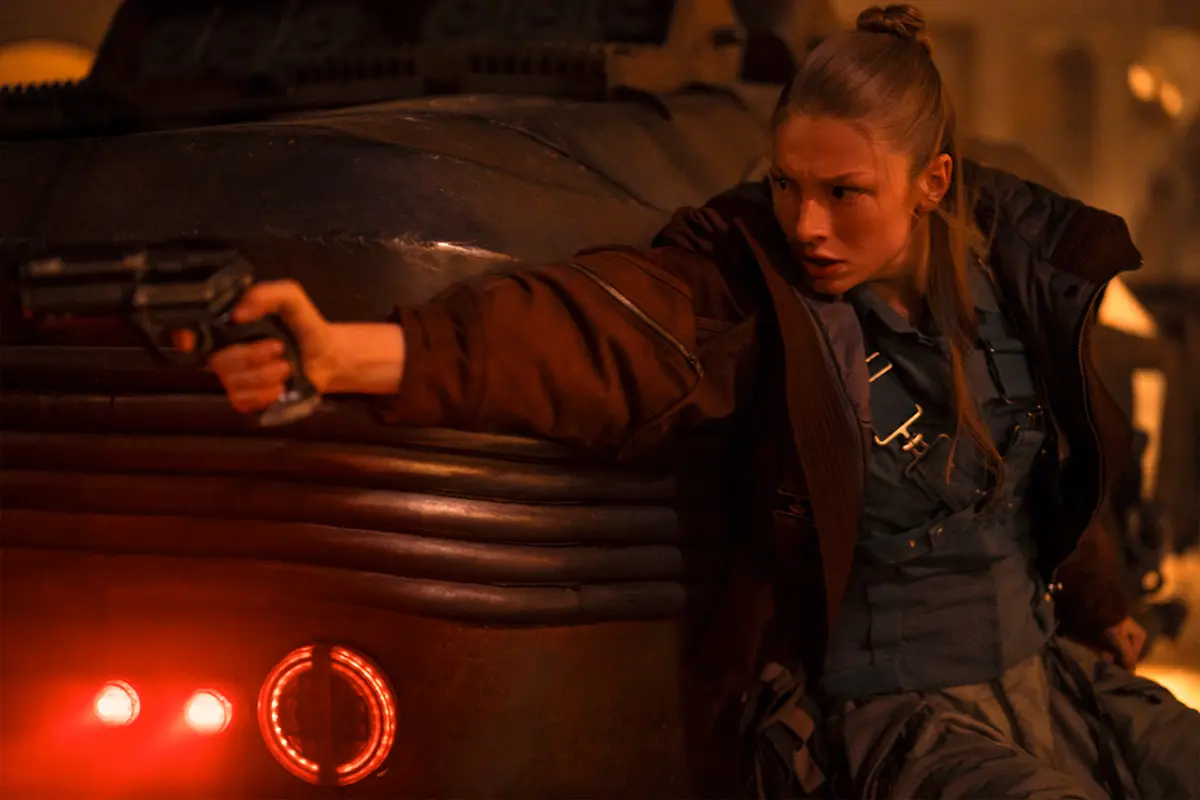
The iconic “Blade Runner” franchise has landed an expansion thanks to Prime Video’s latest installment: “Blade Runner 2099.”
The show is anchored by strong performances from Hunter Schafer and Michelle Yeoh, immersive visuals, timely themes, and thrilling action.
But, there’s a scene where Yeoh says, “this is taking too long” — and that just about sums it up.
Previous “Blade Runner” entries were two-hour movies. This incarnation of the story doesn’t consistently earn its eight-hour run time.
Created by Silka Luisa and exec produced by Ridley Scott, “Blade Runner 2099” is set in a dystopian Los Angeles where Replicants – bioengineered synthetic humans – hold the power.
Humans had intended to be the ruling class, with the Replicants as an underclass, doing menial labor. As the story opens, we’re told that Replicants turned the tables.
The plot follows Cora (Schafer), a human pretending to be a Replicant, as she teams up for a mission with Olwen (Yeoh), a Replicant nearing the end of her life.
The eight-episode show is a sequel to the first 1982 “Blade Runner” starring Harrison Ford, and the 2017 Denis Villeneuve film “Blade Runner 2049” (starring Ford and Ryan Gosling).

Knowledge of the franchise helps; however, viewers won’t be too lost if they watch the show cold.
There’s a handy prologue to explain how Replicants were desirable worker bees, because they could do the work of 20 men, but, “They eat less, sleep less, and don’t get paid.”
Their creators were never worried they’d rebel, because with no families and short life spans, Replicants had “nothing to fight for.” Famous last words.
As much as its plot matters, “Blade Runner” has also always been about the tone and mood. This series dives headfirst into the franchise’s signature noir-meets-cyberpunk aesthetics.
The production design is lavish. The dirt and grime are palpable, in the alleyways between looming dark skyscrapers. Many shots look like, “what if futuristic Times Square was also hell on earth?” (Some people might argue that Times Square is already there).
Similar to the other entries in the “Blade Runner” franchise, “2099” is packed with commentary about class, what it means to be human, and our responsibility over technology.

There’s just enough philosophical elements for the show to dodge accusations of being more style than substance – but the margin is narrow, at times.
The show isn’t dazzlingly original (like other recent sci-fi greats, “Severance” or “Pluribus”). It’s also dour; it lacks those show’s moments of oddball humor.
But, in our current AI age, it can’t be denied that a show about a world that’s been turned inside out by technology – largely instigated by human hubris – is topical.
Oscar winner Yeoh is a powerhouse, as usual. As for Schafer, she rose to fame in “Euphoria.” The provocative HBO series launched its cast into superstardom – Zendaya, Jacob Elordi, Sydney Sweeney. Schafer was elevated into the spotlight alongside them, but her projects took longer to ascend to the same level as her peers.
She’s been more of a supporting player than a lead (in “Mother Mary” starring Anne Hathaway, and Yorgos Lanthimos’ “Kinds of Kindness”).
“Blade Runner 2099” is Schafer’s biggest role to date, and she rises to the occasion. As Cora, she makes a scrappy action heroine. The story has its bumps, but Shafer makes it compelling to watch as Cora keeps fighting for her place in this harsh world.
“Blade Runner 2099” premieres Nov. 25 on Prime Video.
