
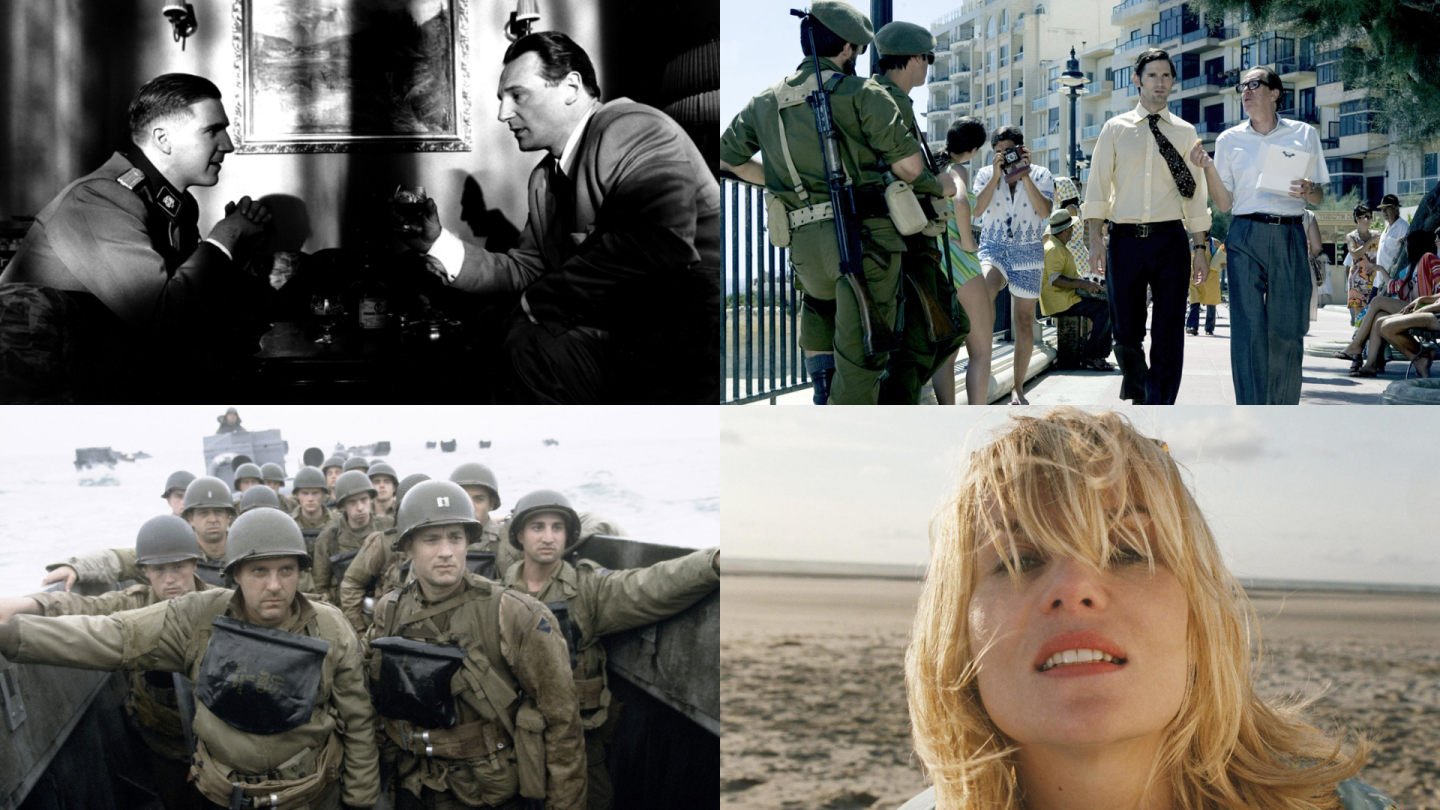
Try to find a signature Janusz Kaminski “look” and you’ll come up empty. Yes, he likes backlighting and has a penchant for smoke and film-noir style. But the Polish-born cameraman, winner of the 2026 THR Visionary Award for excellence in cinematography, has spent three decades making images that bend to the story rather than the other way around.
Kaminski’s guiding principle is that form follows function. With lenses, film stocks, color palettes and camera movement chosen to serve what each film needs to tell its story. The result is a body of work remarkable for its originality and visual diversity. Here are five of Kaminski’s most original visions.
Schindler’s List (1993)
‘Schindler’s List’
Universal/Courtesy Everett Collection
Steven Spielberg’s Holocaust drama was shot in stark black-and-white. The choice wasn’t nostalgic but a way of conjuring newsreels and documentary record, with a handheld immediacy that keeps the audience in the room with the horror. Kaminski’s hard, contrasty lighting, harsh shadows and drifting smoke owe a debt to German Expressionism and postwar European cinema. Against this monochrome, the lone splash of color, the little girl’s red coat, lands as one of the most devastating images in modern film. It won him his first Oscar.
Saving Private Ryan (1998)

‘Saving Private Ryan’
Photofest
For the Omaha Beach landing and the war that follows, Kaminski set out to make combat look like frontline footage rather than a Hollywood spectacle. Colors are leached out to a washed, metallic palette. He stripped protective coatings from his lenses to invite flare and a rawer, less polished image, and used a narrow shutter angle that makes explosions and bullet strikes snap with a jittery, staccato clarity. Handheld cameras and spattered lenses put the viewer on the sand with the soldiers. The look was so influential that it reshaped how war was filmed for a generation, and it earned him a second Oscar.
The Diving Bell and the Butterfly (2007)
‘The Diving Bell and the Butterfly’
Miramax Films
In Julian Schnabel’s adaptation of Jean-Dominique Bauby’s memoir, written by a man paralyzed but for one eyelid, the camera becomes that eye. Kaminski opens the film from Bauby’s first-person perspective: blurred focus, tilted frames, sudden blinks and a claustrophobic narrowness of vision that gradually widens. As Bauby’s imagination takes flight, so does the imagery. Soft, luminous pastels and sunlit memories of Paris and the seaside offer escape from the hospital room. It’s an exercise in subjective cinematography that earned Kaminski an Oscar nomination.
War Horse (2011)
‘War Horse’
Andrew Cooper/Touchstone Pictures/Courtesy Everett Collection
If Saving Private Ryan rejected glossy spectacle, War Horse embraced it on purpose. Spielberg and Kaminski drew on the sweeping, painterly look of classic Hollywood Westerns and epics, with John Ford and David Lean in mind. Anamorphic widescreen frames showcase burnished golds, glowing skies and silhouetted figures against vast landscapes, giving the First World War tale a storybook romanticism before the mud and horror close in. It’s lush, deliberately old-fashioned and entirely suited to a story told through the eyes of a horse. It was another Oscar-nominated turn.
Munich (2005)
‘Munich’
Universal/Courtesy Everett Collection
For Spielberg’s tense thriller about the aftermath of the 1972 Olympics massacre, Kaminski looked to the gritty, paranoid cinema of the 1970s. The film has a grainy, slightly faded texture with muted, earthy colors, and frequently uses zoom lenses, a hallmark of the era’s thrillers, to create a sense of surveillance and unease. The images feel period-authentic without becoming pastiche, and their rough-edged restraint keeps the focus on the moral toll of the mission.
