
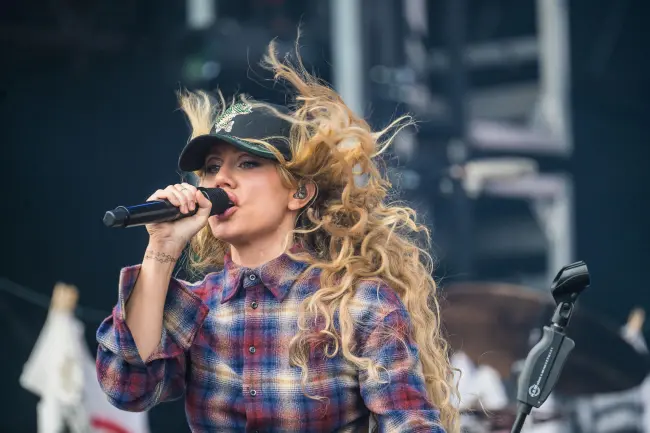
Slayyyter‘s album Worst Girl in America has earned critical acclaim and brought the singer fresh Grammy attention. But renewed scrutiny of racist posts she made as a teenager has complicated her awards-season narrative — and raised a question for voters: Can they separate her music from her past?
The controversy dates to 2019, when posts from 2012 and 2013 on an old account Slayyyter operated as a teenager resurfaced online. The posts included racial slurs and other offensive remarks. She apologized publicly in 2019, then issued a handwritten apology in January 2020, taking responsibility for using the language. The posts drew renewed attention last month, just as first-round Grammy voting was ending.

Grammy history shows that an artist’s past controversies does not automatically disqualify their awards prospects. Lil Nas X, for example, won two Grammys in 2020, but his widely discussed online history (involving a Nicki Minaj fan account) was not the same as Slayyyter’s case. The comparison offers little certainty about how Grammy voters will assess her campaign.
Morgan Wallen offers another, distinct example. His hit “Last Night” earned a 2024 Grammy nomination for Best Country Song, a songwriter category. The songwriters credited for the nomination were John Byron, Ashley Gorley, Jacob Kasher Hindlin, and Ryan Vojtesak; Wallen, whose past includes racist remarks and disorderly behavior, was listed as the performer, not as a nominated songwriter. That nomination, by itself, does not show that the Recording Academy was separating the song from its artist.
Mattie Music Group, which manages Bill Withers’ back catalog, accused Olivia Dean‘s label and related companies of copyright infringement over her song “I’ve Seen It.” The lawsuit did not name Dean personally as a defendant. The plagiarism allegations did little to impact her Gold Derby odds and she remains a presumptive front-runner in the top races.
The timing of the renewed scrutiny may matter: the posts resurfaced as first-round voting was closing. But there’s no way of knowing how many voters saw her remarks before casting their ballots, or whether they affected anyone’s choices. Some voters may accept Slayyyter’s apologies as part of a larger story of personal growth; others may remain unconvinced.
Could Slayyyter regain voters she might have lost? She could choose to address the controversy again, particularly because newer fans may not know she has apologized before. Her announced companion album, Worst Man in America, is scheduled for release Dec. 4, but it falls outside the eligibility period for the 2027 Grammys.
We’ll have an inkling about whether voters might have been influenced by Slayyyter’s remarks when nominations are announced Nov. 16. Right now, she is holding steady at No. 3 on the Best New Artist leaderboard with an almost 96% chance at a nomination (see below). That’s behind only Sienna Spiro and Ella Langley.
If Slayyyter breaks through in the Best New Artist race and other categories, then she’ll have to make another decision: whether or not to address the renewed fallout before final-round voting, which runs from Dec. 10 to Jan. 7.
New Artist
1.

2.

3.

4.

5.

6.

7.

8.

9.

10.

