
SPOILER ALERT: This article contains spoilers for “You Can See Everything,” now playing in theaters.
The question that’s consumed the awards-pundit class since “You Can See Everything” exploded into theaters last week is whether Amanda Seyfried, the unlikely linchpin of this hybrid documentary, can be nominated for or win an acting Oscar. A24 is planning to campaign her for one. Much of her time onscreen is as herself, reacting in real time — but she does, eventually, re-enact co-director Nathan Fielder’s remembered interactions with disgraced tech founder Elizabeth Holmes.
In this, she’s reprising a role that, with the 2022 Hulu series “The Dropout,” already won her an Emmy and a Golden Globe. It’s the role, now that “You Can See Everything” is on track to become one of the most financially successful documentaries in history, that’s become Seyfried’s signature. To this viewer, the question is at once an amusing thought experiment (sure, why not?), and a testament to Seyfried’s compelling screen presence — and more than a little beside the point. For once, an Oscar seems minimizing. What Seyfried’s doing in her most compelling screen work ever is something other, or more, than simply acting.
To be clear, the parts of “You Can See Everything” when she is literally acting are riveting on their own terms. Seyfried simply wears the role of Holmes easily. She’s doubly disadvantaged — in that we’ve just spent 90 minutes with the real Holmes, against whom we can compare Seyfried, and in that we’ve also spent time absorbing just how little Seyfried understands the enigma of Holmes’ motivations. And yet Seyfried somehow creates a coherent and compelling version of a woman we don’t understand, and we know she doesn’t, really, either.
To pigeonhole Seyfried’s appearance in “You Can See Everything” as, solely, an acting performance misses the rawness of Seyfried’s presence here. She allows herself to be seen thinking through a conundrum, as herself, and falling short of finding answers — in other words, after Holmes and husband Billy Evans, she’s the documentary’s other subject. Seyfried delivers a painful and unresolved excavation of the mind of an actor, seeming to land in a place of uncertainty as to how her own past work as Holmes has changed the story even as she willingly takes on the part once more.
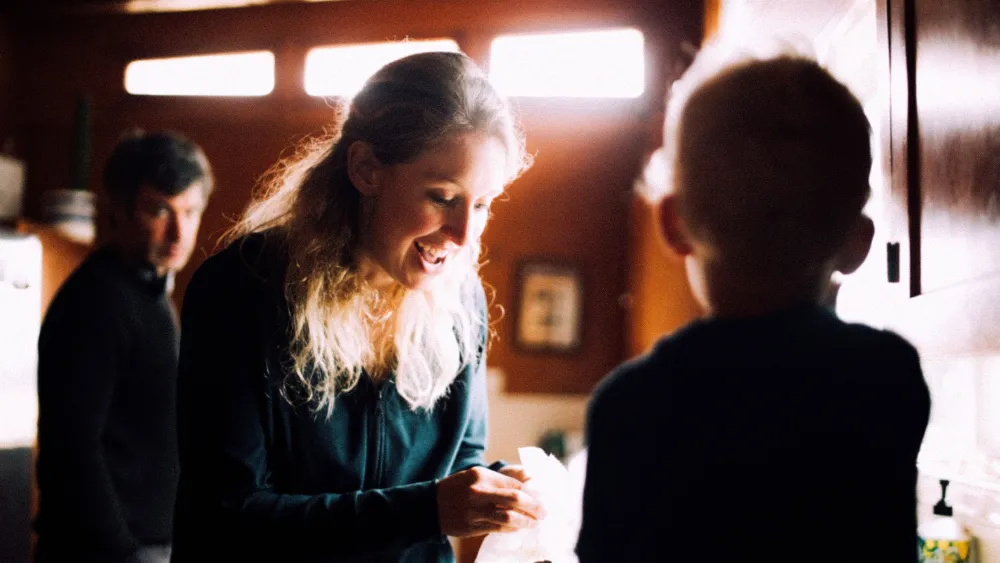
Consider, for instance, the scene in which Seyfried visits Evans at home, after Holmes’ incarceration. This is impressively game and daring. And Seyfried is, I suppose, “acting,” both in the theorist’s sense that all of us are acting our way through life and in the particular that Seyfried has set out to lure information out of Evans to better understand the seemingly bizarre arrangement Fielder and co-director Lance Oppenheim had been excavating before Holmes went to prison. But is she acting, in the traditional sense, when she meets and interacts with Holmes and Evans’ two children, or when she defends her social media post criticizing the late Charlie Kirk against Evans’ mockery? Alternately tender and outraged, Seyfried allows us into her world, just as Holmes tried to. But Holmes, talking past real questioning, couldn’t get there, no matter how all-access her invitation to Fielder had been. Seyfried, by contrast, seems deeply in touch with emotions lying just under the surface. And her increasing befuddlement both matches our own and raises the question of just how deeply an actor can ever understand their subject.
Seyfried, just as Holmes and Evans do in their askew manner, knows her angles. It wasn’t lost on me that within the frame as Fielder speaks to her at her home is a miniature playhouse, of the sort her company Make It Cute sells. That the computer on which she and Fielder watch video of Holmes watching “The Dropout” is propped on coffee table books about Seyfried’s great passion, dogs, and that she and Fielder discuss Holmes while feeding her photogenic horses on her photogenic farm only burnish her brand further. And yet she cannot help but exposing more than she may mean to.
A conversation about the ethics of “The Dropout” — a drama based on real events that, as with any dramatization, used creative license, and that many viewers took as fact — places Seyfried in a surprisingly exposed position. Holmes did not, literally, say and do all the things that Seyfried says and does in the role, Seyfried admits, but she may well have, and the performance overall conjures the sense of a person who is unconcerned with scientific accuracy or with the truth. Shouldn’t that be enough? “I didn’t do that to her,” Seyfried concludes, after attempting to walk herself through a justification of “The Dropout” as plainly not depicting objective reality, no matter what viewers think. “She did that to herself.” She seems to be convincing herself not to feel guilty, up until her final line, delivered with a “It’s Chinatown”-style futility. “It’s very complicated,” she says, having indulged the complications long enough.
Coming into “You Can See Everything,” this viewer saw Elizabeth Holmes’ Theranos as transparently fraudulent and “The Dropout” as an excellent TV show that was in no need of moral justification. Leaving the theater, nothing about those beliefs had changed, but engaging the question of what Seyfried might have owed to Holmes allowed both women to be seen in intriguing new lights. Seyfried, painfully aware of the existence of the two young children she’d met, twists around the question of whether her past work might have been unfair, or have been presented as possessed of a truth its creators didn’t actually know. And in this moment, she seems less to be acting than to be, in a moment of painful frankness I admire her for allowing herself to experience on-camera, acted upon.
Say this much: “You Can See Everything” is undeniably a career high for an actor who has seemed at times in her career like an underdog. (A sliding-doors scenario for the ages: The role of Elizabeth Holmes originally went to sketch comedian Kate McKinnon, and Seyfried got the role only after McKinnon dropped out and Seyfried got a career-boosting Oscar nomination for 2020’s “Mank.”) Amiably loopy in interviews — including in red-carpet appearances at this year’s Academy Museum Gala, where Seyfried sidestepped discussing the film in favor of free-associative Dada — and impressively shifting between genres to avoid being pigeonholed, Seyfried is easy to root for, but can seem hard to know.
Which makes the Oscar talk make perfect sense. Seyfried has gone to a very raw place in “You Can See Everything” — and, not for nothing, has delivered some of the most memorable humor in its second half. (Her growing scandalization at Evans’ control over Holmes’ image and her life allows the viewer a compelling way to stay engaged with the story once Holmes herself leaves it.) But whether or not she can break through in what would, despite vaguely similar precedent — Maria Bakalova in the 2020 “Borat” sequel was nominated for reacting against real life — be close to an unprecedented case, Seyfried has done something more impressive than earning any award. She’s opened up her work as an actor — both her preparation and the moral question of what it means to play a living person — to careful scrutiny, and was vulnerable enough to attempt to talk it through, and to be shown to be uncertain. This appearance, or performance, or whatever, will be discussed far beyond Oscar season. It situates Seyfried as what we ought to have known she was all along: Among the most daring stars of her generation.
