
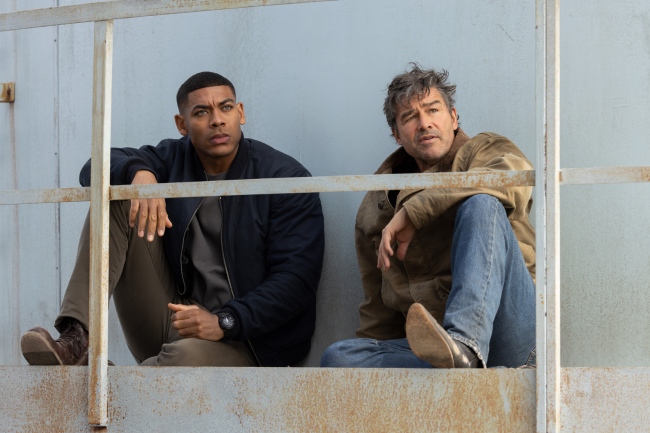
Lanterns wrapped an eventful, admired Season 1 last Sunday, setting the stage for John Stewart’s further adventures in the DC Universe. As Aaron Pierre hinted at during a postmortem chat alongside co-star Kyle Chandler, there will be more Green Lantern action, beginning with next summer’s Superman sequel Man of Tomorrow and, presumably, another season of the HBO hit — especially given new parent company Skydance’s thirst for IP.
One person who’s up for more Lanterns is the show’s Grammy-winning composer, Stephanie Economou. Her companion soundtrack album dropped this week, showcasing themes for John, Hal, and other key characters and locations with nods to 1990s grunge, garage, and electronic music.

Economou joined Gold Derby from her home studio — where she DIY’ed much of the Lanterns score — to break down the main title and major motifs, explain some of unusual instruments, and reveal the artists who inspired her.
Gold Derby: Congratulations. Lanterns is a huge success, widely embraced by both comic book fans and general audiences. The critical acclaim has been off the charts, and your soundtrack was just released. I’m curious: how did you find your way to Lanterns?
Stephanie Economou: They wanted a handful of composers to demo — to write an original piece of music to some of the scenes from the pilot — and then narrowed it down to an even smaller group, and then met us. And somehow out of that, they hired me. By the time I was hired, [co-showrunner] Chris Mundy, Vic Patel the editor, and I already knew we had a vision for the score.
Do you remember what those scenes were that you wrote your original demos for — your homework assignment?
Yes. One of them is the scene where John and Hal drive onto the Macon Ranch for the first time to meet Will Macon. The other was a scene that doesn’t exist in the pilot exactly how it did originally, but essentially the piece of music I wrote for the demo still exists in that pilot episode toward the end — when John returns to Rushville at the end of Episode 1. It’s night, and you flash forward to 2026, and it’s this bluesy vocal cue. That ended up being the theme for Rushville. So that came straight from the demo I wrote.

How familiar were you with the comic lore, or the Green Lantern character, or the Ryan Reynolds movie? Did you know anything?
Not really, honestly. I hadn’t seen the movie — in fact, I only just watched it for the first time last month, and frankly, I kind of enjoyed it. I know there’s so much criticism, but I had a really good time. And Hector Hammond — God, what a character. There was a lot of fun stuff in that movie. But it was nice to see some of those characters in a different light. No, I hadn’t read the comics. I didn’t know a ton about the lore, so I did want to educate myself in some capacity. I got some of the comics, I read some of the Geoff Johns run, and I wanted to see what John Stewart was like and read a little bit about Hal’s origin story. That was useful just to get in the headspace. But ultimately, I was really focused on how to tell this story musically with what they’re doing with this adaptation. So it all came down to how these characters were being portrayed by the actors.
Did you work with the music supervisor to decide what was going to be score? There are some needle drops in the episodes.
Yeah, Gabe Hilfer was the music supervisor. He’s absolutely amazing, and he and Chris worked together really closely, because Chris had some particular ideas about what he wanted the needle drops to be and where they would be. So in spotting sessions, I would always ask, “Is this staying? Do you have any vision for this potentially being score at some point?” We all cared so much about the material and were so committed to what we were doing, and there was a lot of trust between all the collaborators. So we felt safe to go weird places, and it was really special.
You mentioned watching the movie. The score by James Newton Howard is a more like a traditional sci-fi comic book movie — the kind of music you’d expect for a big-budget tentpole. You’re playing in a different sandbox. You’re mixing several genres: noir, mystery-thriller, action, Western, sci-fi. Parts of it feel like listening to KROQ back in the ’90s. There’s grunge and electronic music in here. But you also have unusual instrumentation and there’s even a neo-spaghetti-Western vibe, with jangly guitars. All of this comes together, and it works. It’s not a bombastic movie score, and it serves the series well. That must have been a fun challenge for you as a composer — yes, it’s the conceit of a superhero show, but there are so many more layers you can play with.
Yes, and thank you for saying it all feels cohesive, because that’s the risk you run when you do a score like this. I had a lot of ideas and a lot of different character themes. As you said, there’s some rock-influenced stuff, some electronic and trip-hop-influenced stuff, and then significantly more experimental, sci-fi-ish themes. The Lanterns theme in and of itself is very different — there’s a little Nine Inch Nails in there, but it definitely gets more cosmic and mysterious and grand.
So it’s a challenge trying to bring it all together. But they made this comic story such a different interpretation, and I felt like the music needed to follow suit. Just because something exists within a superhero genre or narrative — I mean, what even is that, right? Music can be whatever. I was really focused on how to expand and evolve the palette, the instrumentation, and the themes over the course of the season, and make it feel fitting to these characters and this world. That was my ultimate goal, and it led me down all of these paths. It felt natural to go certain places, because even though it’s a grounded story, you have aliens, you have Manhunters, and you have this setting of rural Nebraska — which is kind of where the blues-rock influence came from. I was trying not to tip too much into the spaghetti-Western side of it, more a Mark Lanegan and Nick Cave kind of thing, but the tone of that is there. So getting to expand and contract within those creative parameters was really fun.
I want to talk about a few of the specific cues, starting with one you briefly mentioned — the Lanterns theme. What was your vision for that specific theme?
I wanted the Lanterns theme to be reflective of the Green Lantern Corps as a whole and the ethos of the Corps, and I wanted it to feel separate from the other themes. John and Hal’s themes and the Rushville theme were all pulling from these rock roots, and I didn’t necessarily want that for the Lanterns theme. I wanted it to feel cosmic and mysterious and really grand … a really simple tune that you’d remember, but surrounded by other unique elements. So I sat down and wrote it on piano — and oftentimes you do hear the theme on piano. But then I wanted these really warm analog synth chords underneath, bending back and forth from one another. I thought it created a sense of instability. You have these chords, you have the piano theme, there’s sometimes a single pulsing piano note, a bunch of processed strings often end up on that tune, and this great instrument I use everywhere, which is a rubber-bridge guitar. There are intertwining layers of it that create a rhythmic motor. Oftentimes you only hear one element of the theme — it’s not always all together, as you hear on the soundtrack — and it’s fun to tease that.

There are so many moments throughout the series, like John holding the suit up to himself for the first time, where it’s not always this one big realization of the theme. There’s an element of setting it up and planting the seeds, and making sure those elements on their own stood out as something different from the rest of the score was really important to me.
The John Stewart theme starts out very regimented, much like the character, then it gets more layered as the cue progresses. I assume that was intentional?
That was exactly my approach for John — to get in his head as a character. He is so steady and so dedicated. I picked up that baritone rubber-bridge guitar and started strumming these chords that were very straight — very regular, very regimented, like him.
But I also wanted to capture the sense of loneliness he carries around with him everywhere. You see how isolating his childhood was because of the training with his family, and then he goes on to this great military career, and you see his devotion to that work, and to his art and architecture. So I needed that steadiness to be part of him. But he’s also pretty badass. So along with that guitar strumming, I wrote this electric bass riff on top of it. The rhythm appears quite steadily throughout the whole series — but as the season goes on, you hear it more on distorted electric keys with really close-mic’d percussion, or with a bunch of synths surrounding it. It gets reframed in a lot of different ways, and then he gets big action sequences where you really hear it go full action-hero. So there’s a lot of ways his theme got interpreted, but the genesis was thinking about who he is as a character — this steady force.
And then, on the flip side, we have Hal Jordan, who’s older, at a different point in his life, a little more jaded. How did you approach Hal’s theme?
John and Hal’s themes share a lot of similar instrumentation — guitars, drum kit, a bunch of stuff that overlaps — but the lens is very different. For Hal, because he’s this older, rugged, jaded guy, a bit of a cowboy, I thought more of garage rock with a little blues influence, very early Black Keys.
Whereas John was a lot more influenced by Nirvana and Alice in Chains. A lot of the percussion that follows Hal around is just found percussion that I gathered — empty beer bottles and scrap metal and wood and random stuff that feels like him. He’s scrappy, he’s rugged.
And full of beer.
Yes, exactly — he finished all the beer. So it felt more like him. His main theme is a bass riff, sometimes on baritone guitar. Later in the season, in the future timeline, I recorded it on violin string harmonics, so it feels a little more isolating and haunting. So that gets put through its paces too, in different frameworks. But the attitude of Hal’s theme is very different from John’s. Hal’s theme is not straight — it’s very syncopated, it’s got a swagger to it, it’s more unruly.

Episode 3 is one of the standouts, we get the John Stewart backstory, meet his family, and witness everything they put him through to become a Green Lantern. One of the cues is called “How Do You Make a Green Lantern?”
Episode 3 is my favorite, and I really loved scoring it. It’s rare that you get to see someone’s origin story all in one episode, and I got to expand the Lanterns theme quite a bit in it. That track you’re referring to, “How Do You Make a Green Lantern?,” was the most I used piano in the entire score, and it felt so right for the moment. You have John’s parents holding baby John, sleeping, whispering in hushed tones about how they’re going to permanently alter their young child’s life to give him what they feel is this impossible, great opportunity to become a Green Lantern. There’s this weird synth I programmed under the piano, so you have this pulsing piano, which I wanted to feel like the gem of an idea they’re putting together — “How do we do this? How do we raise him to not feel fear?” — and then the synth underneath is bending in half steps and strange ways to communicate how unsettling it is, frankly, but also quite intimate. This intimate moment, and this choice that is life-altering for their family.
And then it suddenly jumps ahead to John on his military mission, jumping out of a plane, and you hear the Lanterns chords — not the tune, but the chords — on big strings and synths, all bending together. Then you hear John’s theme on bass. That whole track goes quite a few different places. But to be able to tease these ideas of the theme — with John as a child, flashing forward to John as an adult, and how these moments have turned him into who he is — it’s a cool thing to get to tell that story musically.
The first part of the series ends in Episode 5 with the big Rushville attack, and there’s some really amazing music in there as Lanterns has this full-throated action superhero moment.
Episode 5 is such a massive episode — a ton of music, the most music in the whole show. You get a lot of the Macon Ranch sound, which is that Nick Cave feeling; lots of the alien theme for Antaan; lots of John being a badass and Hal being a bit of a twit sometimes; and some Lanterns moments, too. When Hal comes out of that massive cloud and throws Antaan into the sky, you get a big Lanterns theme quote there. It was so fun — just so high-octane the whole time. And something every composer needs to keep in mind with such an action-packed episode is how you’re shaping the tension in the action, because you never want to let anybody off the hook. The temperature of the tension needs to be perfect every step of the way; otherwise, you feel like you’ve let your foot off the gas. So that episode was very heavily curated to make it seem like, “OK, it’s a powder keg.”
“Fear and Love” in Episode 5 is the moment where John kills Zoe, and it does this — I hate to say it, but it’s true — Portishead sort of electric-keys thing. It’s something I teased in the previous episode, in his and Zoe’s love theme. Those keys feel quite lonely but also intimate, and it felt natural to reprise that. When he kills her, he literally has her in his crosshairs, and he says, “I see you.” I ended up putting that toward the end of the soundtrack, even though it comes in the middle of the series, because it felt like a closing moment emotionally for John, a pinnacle moment for him. So I put it as close to the end as I really could. That was a really fun one to write, and I loved being able to evolve John and put him in these different musical spaces. He and Zoe have such a specific sound world — it’s a lot more synth-driven — so that was really fun to do.

You wrote a song for that episode titled “Away From Home.” Was that something they asked for?
No one asked for the song — such a composer thing to do. I initially wrote it for the moment right after John kills Zoe, when he’s walking through the rubble at the motel and he sees Maggie as a kid, and her mom, over their father’s dead body. I wanted the Rushville theme to be there, the Rushville theme from my demo that appears in Episode 1. That felt like the moment to do it, because they sort of became collateral damage in this whole cosmic warfare. And because the Rushville theme was a vocal theme anyway — it was tonal vocals, kind of oohing and aahing in the first episode — I thought, why not graduate it to an actual song and have lyrics there? So that’s initially where I wrote it. I wrote the first verse and first chorus for that moment in the body of the episode. [Chris said], “I really love it,” but here’s where a needle drop came into play. Immediately after that scene — like 90 seconds later — a song came in, and that ended up being a Bon Iver song. He said, “I really love it, but it feels like too much to have two songs back-to-back.” So we decided to make the vocals in that moment in the episode tonal — oohing and aahing — but still essentially the same piece of music, a little remixed.
Then we put the song in the end credits, and that’s how it was born. It started as this 90-second mini-song, and I thought, “I have to expand it to a full song for the soundtrack.” So in the end credits, it’s the final song, but truncated to fit the length of the credits, and the soundtrack has the full version, which goes pretty full rock. I feel like that’s the biggest rock statement in the whole score — the bridge and the final chorus of that song. It was pretty special.
The reason I wanted to make that video — we kind of didn’t even intend to. We were shooting some behind-the-scenes stuff, and we accidentally shot so much that we were like, “We could do a music video.” It’s nice for the fans who really listen to the soundtracks.
For a show about space cops, we really only go into space once — that dead yellow planet where Antaan’s people were from. That music needs to be different.
I wrote the theme for Antaan and the aliens in general. That was one of the first themes I wrote, because I was so excited about the idea of writing something very bizarre and unsettling. I wrote it away from picture, and I thought, “OK, this could be something.” Originally I thought it was going to be the theme for the Manhunters, but Chris thought it was better suited for the aliens, so they put it in that episode the second they walked through the portal, and they loved it.

I was hearing these motifs in my head, and I wanted to be able to reverse all of them individually, because it makes it feel — it gives it more edges. It creates unexpected dropouts and punctuation. I play violin and viola, so I picked up a viola, recorded these motifs, and then reversed the audio. Then I layered it with other things — I picked up a trombone mouthpiece and made weird sounds into that — and from there took those layers and heavily processed them: degraded, distorted, heavily pitched. But it’s an organic sound, and that’s what became the alien theme. It follows Antaan around everywhere, and the second you step on Antaan’s planet, it gets recontextualized.
I layered a bunch more strings, put some brass in there, some synths, and it becomes more of a tragic representation of that theme as John is piecing together what Antaan made him see, finding these skulls on the ground. I wanted it to feel almost operatic and really deeply emotional — whereas a lot of the other times Antaan pops up, you hear these weird, insidious motifs. It’s like, “Ooh, he’s creepy, he’s alien.” Now you almost feel it’s more humanized. So that’s essentially what’s on the alien planet, along with some unexpected, distorted synth percussion and dropouts and different textural components that make it, I hope, unique compared to a lot of the other score themes.
Are there any cues that you really loved making, or that you think fans should pay attention to when they dig into the soundtrack?
We did this great thing with the soundtrack that I’ve never done before, which is we released a single off of it every week with each episode. But one of the singles I wanted to release and didn’t end up doing was the track called “Manhunters.” That Manhunters theme is probably the theme that gets played most throughout the entire season, and it’s teased in so many ways. It’s this weird distorted upright bass and duduk thing that I did.
I really like that track — it’s basically a suite of the Manhunter moments. But then you hear the Manhunter theme in a lot of other tracks through a totally different lens. You hear it a little more sympathetically, especially some of the stuff in Episode 5 with Zoe. Then you hear it in Episode 8 with Noah in a really fragmented, bizarre way — you hear it when he asks John to kill him. It’s pretty much everywhere, and it’s fun to spot that theme. I’m really happy I got to write a proper baddie theme. It’s really slithery and weird and unusual. So I’d like to shout out that track, and I hope people like it, because it just became available on the soundtrack.
I know it’s early days and there hasn’t been anything official, but the showrunners have hinted at it, Aaron’s hinted at it — there’s probably more Lanterns coming in the future. Have you given any thought to ideas you’d like to expand on, or are you like, “I’m done, Lanterns, I’m moving on to something else”?
No, Lanterns will never leave me. Honestly, this is one of my favorite scores that I ever got to work on. I hope so much for more seasons — many more seasons — because I think this Lanterns theme can be taken into so many different corners of the galaxy. John’s theme is so ripe for more things, and I really want to explore that. And I’m excited for some of these themes maybe to recur — the alien theme maybe coming back, but for different characters or a different species; the Manhunters coming back. I don’t know what they’re doing, but I’m open to what all of these possibilities mean, because I felt like we set up so much in the musical storytelling that I’d love to keep it going.
And we know John Stewart is going to be in Man of Tomorrow next year. I hope they can quote some of your music as connective tissue.
I hope so, too.
This interview has been edited and condensed.
