
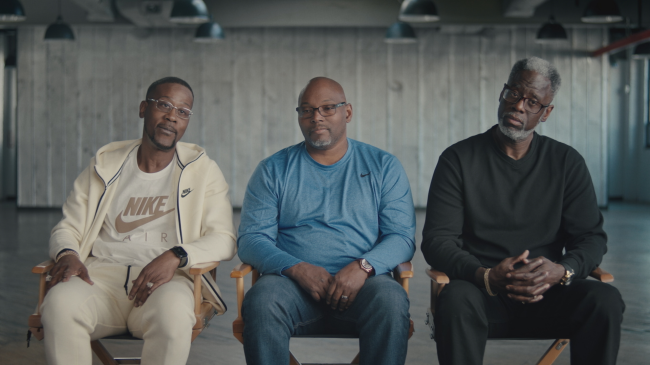
When veteran documentarian Dawn Porter first met with Andrew Stewart, Ransom Watkins, and Alfred Chestnut, the subjects of her documentary When a Witness Recants, they asked her just one question: “Are you going to tell the truth?”
“That hits really hard when you realize what happened to them,” Porter tells Gold Derby.
Stewart, Watkins, and Chestnut, collectively known as the “Harlem Park Three,” were wrongfully convicted of the murder of 14-year-old DeWitt Duckett at Baltimore’s Harlem Park Junior High School in 1983. The then-teenagers were sentenced to life in prison based largely on the false testimony of other children, who were coerced by Baltimore police. Each served 36 years before they were exonerated in 2019, when the case was reconsidered. Their combined 108 years behind bars make up the longest wrongful conviction in American history. If there’s anyone who knows the damning power of a lie, it’s them.


“I’d never heard of anything where so many supposed safeguards failed, and I’ve done a number of films about the legal system and wrongful incarcerations,” says Porter. “A police officer coerced children, interrogated them without their parents. Then prosecutors did not listen when the children tried to say, ‘This isn’t really what happened.’ Then a judge suppressed clearly exculpatory evidence. Multiple people identified the actual killer, and then the appeals were denied.”
In When a Witness Recants, Porter helps Stewart, Watkins, and Chestnut tell their story on screen for the first time. HBO and executive producer Ta-Nehisi Coates first approached her about directing the project after Coates read a New Yorker piece about the Harlem Park Three and thought the story could shed light on wrongful incarceration. Having directed films like Gideon’s Army, John Lewis: Good Trouble, and Rise Again: Tulsa and the Red Summer, Porter was a natural fit.
When a Witness Recants, which premiered at the 2026 Sundance Film Festival and premiered Nov. 17 on HBO, is the trio’s first documentary, but it wasn’t the first offer they’d received.
“They had been approached by a lot of people when they first got out of prison,” says Porter. “It was a pretty big story in Baltimore and got a lot of coverage. They, I think really wisely, said, ‘Let’s take a beat. Let’s adjust to living.'”
Porter and Coates traveled to Baltimore without cameras to pitch a documentary, but also to gain the men’s trust and assure them that the film would be, above all, truthful.

“The first thing Ta-Nehisi did at the meeting was say, ‘I am sorry.’ That really set the tone for our interactions,” says Porter.
From there, Porter went out of her way to make sure Stewart, Watkins, and Chestnut were prepared for the sometimes demanding process of filming a documentary.
“I’ve done a lot of interviews with people who’ve been incarcerated,” she says. “You run the risk of re-traumatizing them, so as a director I try to minimize that. Prison is really loud and chaotic, so people get triggered if they’re in a space that is not quiet and calm. I always tell people, ‘This is your interview. If you need to take a break, take a break. If you don’t want to talk about something, it’s your interview.’ You try to give people back some power. That’s really important where people have been so violated for so long.”
“But over time, they opened up more and more and more,” Porter continues. “I think they had been waiting to tell their story and explain the horrors and the nightmare.”
The interviews were emotional for the trio, and Porter was surprised by how much their stories affected her as a director.
“Sometimes you cry during interviews,” she says. “And I have two boys who are in their 20s. Alfred was calling his mother and asking for help. There are few things more horrifying than not being able to help your kid, and I responded as a mother.”
Stewart, Watkins, and Chestnut sit at the center of Porter’s film, but the focal point of the original New Yorker piece was Ron Bishop, one of the witnesses who testified against the trio when he was just 14 years old. As the documentary charts how far-reaching the impact of a wrongful incarceration can be, it follows the Harlem Park Three and Bishop on parallel tracks.
From the very beginning of the project, the plan was for Bishop to meet the Harlem Park Three on camera.
“He hasn’t said this in as many words, but I think one of the reasons Ron did the film is because he wanted to see them,” Porter speculates. “He wanted to get in touch. He wanted to apologize in person, and so all along the time of filming, he was saying he wanted to meet them, and they also said, ‘Yeah, we’re ready to see Ron.'”

Over two years of filming, however, Porter began to feel uncertain about the reunion.
“I started having hesitations,” she remembers, “because I was worried that Ron rightfully was celebrated for coming forward, but he was focusing on the hero part a lot, and not on the other part.”
The other part is that a lie he told left three men in prison for 36 years, and that he never came forward in the decades in between, even though he knew the Harlem Park Three were innocent.
“Each side is saying they want to meet,” says Porter, “and so I had a conversation with the three, and was like, ‘Are you sure you want to do this? It’s been a really long time.’ And they said, ‘Nope, we are ready.’ I talked to HBO about it and said, ‘I am actually not a fan of doing this.’ But the HBO executives are really experienced in these types of stories, and they said, ‘Well, each of the parties wants to do it. You shouldn’t step in and stop it.'”
Without spoiling the raw emotion of the reunion sequence, the documentary’s third act shows why Porter was concerned. Instead of a feel-good ending where the four men reconcile, what follows is a tense exchange. Porter believes that ending shows the consequences of wrongful incarceration better than an easy reconciliation would.
“The meeting shows you can’t fix this,” she says. “As much as everybody would like a neat kumbaya ending, we have to stop wrongful convictions from happening because you can’t fix it. … No amount of money is going to make up for what they lost. To me, it’s a more satisfying film because it’s really honest. They can have both empathy for Ron and be really enraged. The thing about these circumstances is that everybody loses something.”
And yet, over the past year, as Porter and the Harlem Park Three have traveled the world screening the film at festivals, she has seen some form of healing take place.

“I find [When a Witness Recants] hard to watch,” she says. “Especially now knowing them as people, I get so angry and upset. I don’t watch it unless I have to, but they watch it every single time. They have participated in so many Q&As, and one of the things they told me is that watching people care about them is helping them believe in people again. This is part of their healing, and I think that’s why they watch every time. They’re getting some comfort in the fact that we are outraged and upset.”
In the end, speaking the truth was the healing that they needed.
