
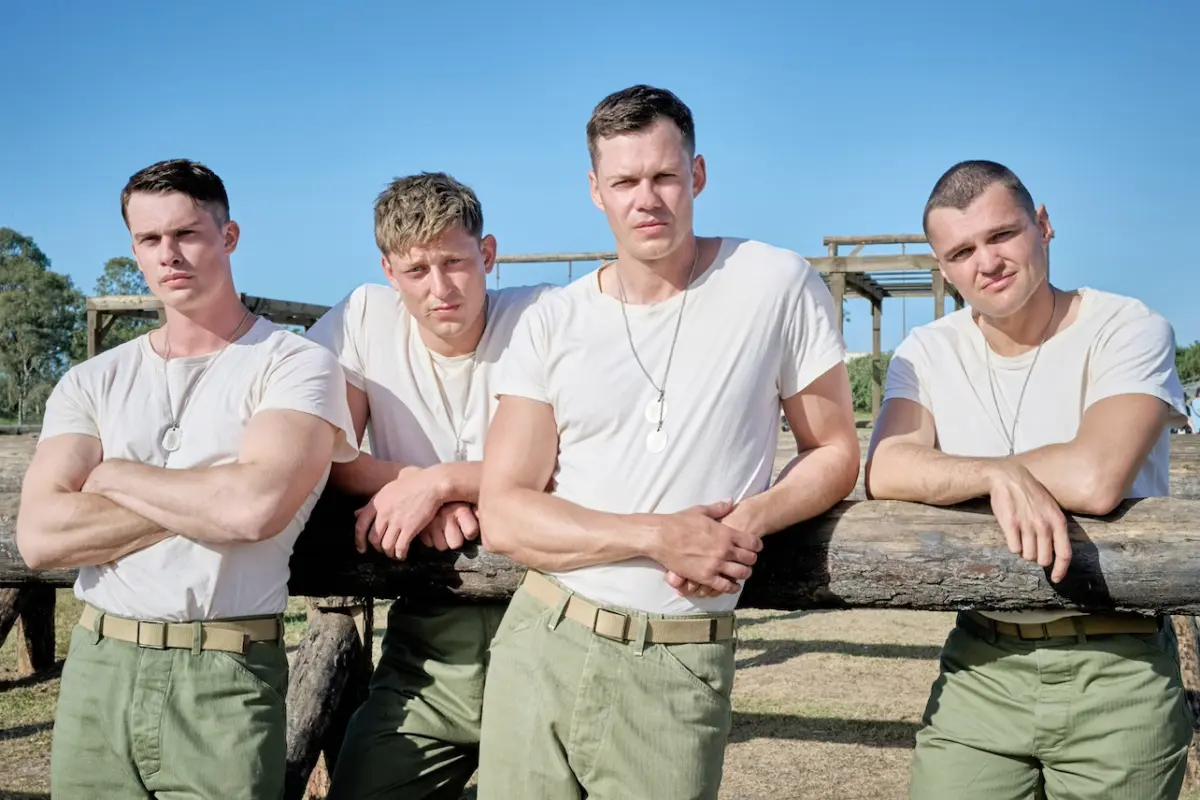
The Mosquito Bowl (now on Netflix) reminds us how football and war often share the same language. This BOATS (Based On A True Story) movie is by Peter Berg (Friday Night Lights, Hancock, and more Mark Wahlberg action-dramas than may be healthy), adapting Buzz Bissinger’s novel The Mosquito Bowl: A Game of Life and Death in World War II, about college football stars-turned-Marines who staged a football game between Pacific theater skirmishes in 1944. And the movie asserts that “going to battle” is far more preferable on the gridiron with the ol’ pigskin than in the trenches with guns and bombs — not exactly a revelation.
The Gist: In this movie, everything is gray, even at Brown. That’s where John ”Mac” McLaughry (Nicholas Galitzine) plays ball in all the mud and the rain and the glory. Same for Purdue star “Touchdown” Tony Butkovich (Ray Nicholson, son of Jack), who tramples Wisconsin’s Bob Baumann (Bill Skarsgård) and bitter rival Dave Schreiner (Tom Francis) on the way to victory. These are rowdy young randy roughnecks full of piss ‘n’ vinegar at the bar and violence on the field. They get the girls and their mothers dote on them. Mac’s girlfriend (Ellen Newton) doesn’t understand the adrenaline rush he feels when he’s in the pads and cleats — except, she says, when they’re making whoopie (I’m paraphrasing). It’s 1941.
Specifically, it’s 1941, the day before Pearl Harbor. Berg inserts real-life historical clips of that awful day, then establishes our four principals as soon-to-be Marines who end up in the same battalion. Mac is steady as she goes. Bob is a bit of a jokester. Touchdown Tony is a celeb drafted to play pro, much to grim-faced Dave’s irritation. They get abused at boot camp — notably by a typically shouty drill sergeant played by grating ESPN football commentator Pat McAfee –—and then it’s 1943.
More specifically, it’s 1943 in Tarawa. Our Marines are in a boat headed for the beach as boats and planes launch shells and bullets in every direction. The boat grounds on a reef and the men jump out as bullets rip through the water and they swim and lose their guns and helmets and they get filthy as they crawl up embankments and they lose innocence in torrents as they watch fellow Marines get their limbs blown off and their cavities filled with bullets and accidentally pick up a helmet with a head still in it. They’ll truck through the jungle, the targets of snipers, soaking up trauma and more trauma like sponges that’ll never dry out. Eventually, it’s the eve of the Battle of Okinawa, and a superior officer orders our four gridiron guys to put together a football game to raise morale. So they do. It’s Christmas Eve, 1944.

What Movies Will It Remind You Of? So, so many WWII movies since Saving Private Ryan try so, so hard to remake Saving Private Ryan.
Performance Worth Watching: Galitzine is our primary protag, but he’s weirdly passive; Nicholson shows charisma while Sarsgaard and Francis have their moments.
Sex And Skin: Bare manbutts as our guys bathe in the ocean.
Our Take: During a rare quiet moment, Berg and Mark L. Smith’s script drops in a bit about “nuance” in the Marines’ mission, and as the four principals discuss what that is, the moment feels terribly ironic in a movie exhibiting no nuance whatsoever, from its dingy color palette to its thrashing handheld cinematography and klutzy dialogue. It depicts the Japanese as faceless at best and suicidal maniacs at worst, and some Americans are gruesome collectors of skulls and teeth, like serial killers who found the only place in the world where their impulses are acceptable. Caught in the middle are these four footballers-turned-fighters who hadn’t experienced much hardship but now have seen way too much for any person to endure. WAR IS HELL, Berg yells into our faces.
And then there’s the violence, gruesomely graphic, which in Private Ryan established an unforgettable baseline for realistic depictions of war, but here feels exploitationist, just a shade this side of Mel Gibson-style sadism. Making us care more about these one-note characters might function to make the violence more emotionally impactful; as it stands, it does little more than urge us to gawk at the horror.
Berg contrasts the gore with the rah-rah game, a slice of fleeting joy for these men and the movie, reducing the moment to an all-too-brief highlight reel before getting back to the carnage, buffered by an insistence that we care deeply about characters we barely know despite spending two hours with them, and a weirdly sentimental tribute to the real men who died after that game, and an even weirder, more heavy-handed critical assessment of war itself (punctuated by archival footage of the mushroom cloud over Nagasaki). The Mosquito Bowl has too much blood and guts, not enough heart and soul.

Our Call: To be stupidly reductive, Berg fumbled the ball. SKIP IT.
John Serba is a freelance film critic from Grand Rapids, Michigan. Werner Herzog hugged him once.
