
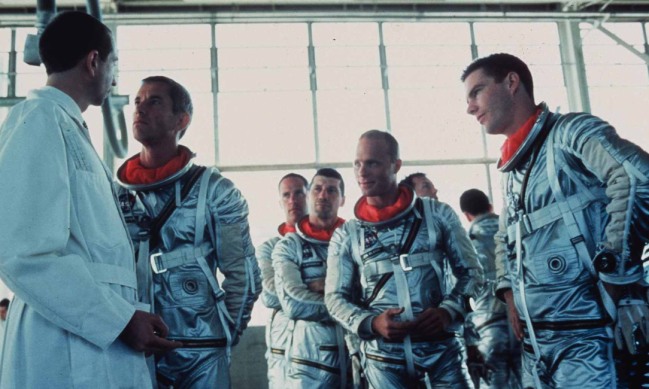
For more than 60 years, Philip Kaufman has been both a Hollywood fixture and an entertainment industry iconoclast. His first film, Goldstein, drew raves from the likes of Jean Renoir and François Truffaut after sharing the Prix de la Nouvelle Critique (with Bernardo Bertolucci, no less) at the 1964 Cannes Film Festival. He made a superhero film (Fearless Frank) and a raucous, vérité Western (The Great Northfield Minnesota Raid) before delivering one of the greatest horror remakes of all time, Invasion of the Body Snatchers, in 1978. Yet it was The Right Stuff, Kaufman’s adaptation of Tom Wolfe’s book about the earliest days of the U.S. space program, that most fully showcased his many talents: it was nominated for eight Oscars and won four.

Newly remastered in 4K for Criterion, the film’s spectacular yet subdued charms — it was a box-office flop upon release — get a chance to shine anew. Kaufman was kind enough to speak with Gold Derby about that film and many of his others during a lengthy telephone call. Discussing the ins and outs of that production, as well as of The Outlaw Josey Wales, The Unbearable Lightness of Being (which earned him an Oscar nod for Adapted Screenplay), and Henry & June, Kaufman repeatedly highlighted what Wolfe called “the right stuff” — a quality that went into all of his work, not just that particular adaptation, and which made him such an unforgettable presence in the industry, even when his work landed him on its outskirts.
Gold Derby: Your debut film Goldstein won an award at Cannes, and Jean Renoir called it the best American film he’d seen in 20 years. I’m curious what happens for a young filmmaker when they’re getting compliments from Jean Renoir at the beginning of their career.
Phil Kaufman: Well, I never quite got into that thing of careerism. I had wandered around Europe and done different things with my family, and my influences, Henry Miller and so forth. And it was great when Renoir said that great thing about the film — I wasn’t there, but it was confirmed to me by many years later by [producer] Tom Luddy, who had been at that screening where Renoir stood up and said, “This is the best American film I’ve seen in 20 years.” And I don’t know, I guess you hope that you can get some money to make another movie off of that. You bask in the glow of that, but I was reluctant, always, to get into that Hollywood system of making movies — even though I ended up doing some movies in Hollywood. And in some ways [The Right Stuff] is a Hollywood movie, but I basically moved it all up to San Francisco and drove a lot of people crazy by doing that. There were a lot of battles there, and I was lucky that Bob Chartoff was a really understanding producer, and there was a guy at the Ladd company named Gareth Wigan who I fought with every day, but we had the greatest respect for each other. He understood that we were going for something different in this movie, and with the filmmakers I like — Renoir, of course, was chief among them — there’s an exploration that’s going on, whether it’s human nature or space or whatever.
You had success a few years later with The Great Northfield Minnesota Raid. Revisiting it for our conversation, what jumped out at me was the baseball game in the middle of the movie that seems to be completely detached from the raid itself. It reminded me of those more mundane details outside the space program that are in The Right Stuff.
Bobby Duvall, my dear departed friend, I thought was a brilliant Jesse James and he is looking for vengeance — he’s an angry guy, really. But Cliff Robertson’s character [Cole Younger] is curious about things, a little bit more looking to the future. And you find the future in Northfield where people were playing baseball. Baseball is just Americana. Planting your film in the reality of what might have gone on is really important. I was influenced certainly by Renoir, but by Truffaut, Jules and Jim and so forth, where world events are going on around the relationship of a Frenchman and a German. [Also,] my good friend Nelson Algren, who wrote The Man with the Golden Arm, A Walk On the Wild Side and so forth, [said] you look at your times through characters and their personal relationships and the world that they lived in. And Minnesota was the Midwest and baseball was the Midwest, so whether it’s humorous or whimsical or whatever, I just feel like that was part of the American experience.
Why were you interested in Jesse James?
One of the reasons why I was going to teach American history [after] graduate school at the University of Chicago was that I felt that the history books and movies didn’t account for the real Jesse James. And all of these things are a little bit like The Right Stuff — who are the real astronauts? John Glenn, behind the scenes, what was he really like? And Gus Grissom, what was all of his agony [about] after he didn’t come through with the traditional American glory? They gave him a small parade and he’s in a little apartment with nothing — they hadn’t even stocked his refrigerator — and he suddenly has to go out and deliver the standard spiel about what the public wants to hear. And [those human details] are what they should hear, what we should know more about — not as gossip, but we need to know that we’re all human beings. I mean, Chuck Yeager couldn’t be more normal in some ways. And yet I remember walking through Edwards Air Force Base and asking him [about] those little rat shack houses that they lived in, “Who were your friends?” And he said, “You know, we didn’t really have friends, because a lot of them would be gone tomorrow.” So it was just him and Glennis. I felt a little bit like that with Rose and my son Peter — we sort of wandered around Europe just trying to make sense of what we were doing and what our life was. And I just couldn’t attach myself quite to that, hate to say, film school ambition about getting deals in Hollywood and so forth. None of that ever appealed to me.
For a time, you worked on The Outlaw Josey Wales. There are conflicting accounts of why that happened, but what lesson did you take from that, given your ambitions outside the prevailing expectations of establishing yourself in the industry?
I really don’t want to get into that — I wrote the script and was directing it, and then I wasn’t directing it. What happened there was kind of brutal and life goes on.
Sorry — I’m not trying to ask what happened. But were there lessons you took with you when you went on to subsequent films?
It’s hard to say. I mean, I was going to direct Raiders of the Lost Ark. I’d been working on that with George [Lucas] and I got offered the Eastwood film and Eastwood was a friend of mine, and he was somewhat of an outsider to the mainstream Hollywood experience. He’d done those European spaghetti westerns with Sergio Leone. And just for various reasons, didn’t work out. And I already I was in San Francisco, and [when I made] Body Snatchers and The Wanderers, I was still living and editing in San Francisco. I wasn’t really living down in Los Angeles, which the years that I lived down there were somewhat difficult for me. I was offered an Elvis Presley movie and I didn’t like the script, and I was offered movies of the week and didn’t want to do that. I was lucky to be living in Malibu — we found a little place on the wrong side of the road in Malibu colony. I lived next to Susan Strasberg and there was a shared tennis court that came with the house and Duvall and I played tennis regularly all the time. I remember playing against James Caan and Duvall when they were doing The Godfather, and they and they stayed in character, sort of talking to each other like mobsters. I had a great time and I wanted to make movies, but I really didn’t want to get into making the movies that I was supposed to be making if I wanted a “career.” I wanted to be a filmmaker, not to have a career. I mean as far as money goes, I think on Northfield Raid, I was under contract there, but I wrote, directed and produced the movie for $10,000.
As you said, you were going to direct Raiders of the Lost Ark. What doors did that open, on top of making Invasion of the Body Snatchers, for you going forward?
I didn’t have much to do with that, really. I was going to do it and I spent months with George going over and it wasn’t until a couple years later I forgot exactly the sequence of that, but I don’t know if that really any had any influence on The Right Stuff. That was just something where George called me a couple of years later and he was on the beach in Hawaii with Spielberg and he told him about the idea we had and that they wanted to do it and so I said fine, great. I told Larry Kasdan what I could — I think I was doing Body Snatchers at that time — and so I didn’t have anything to do with the actual working on the film. My name just stayed there because I was part of the inception of the project. So who knows? I don’t really talk about it that much, because I didn’t have much to do with it.
What I’m reminded of every time I watch The Right Stuff is how funny it is. Was that tone borrowed from Tom Wolfe’s book, or was that something that you felt was important to prevent the adaptation from being too jingoistic?
It does stem from Tom Wolfe’s book. I was a big fan of his other work, all of which was funny. He always had — I don’t know, it goes beyond wry, an amusing look at America, but realizing that at the core of things, there is serious adventure going on, the American adventure. And you used the word jingoism, that tends to in my mind lessen the impact of everything. It makes things trite, especially when you have something as monumental as the Mercury astronauts. And from the very beginning, we know that death is at stake, but it’s not necessarily the journalists who are really assessing the human cost of everything that’s going on. They were sort of reporting it all like a ball game. And Tom was really after something sublime, and that’s what I felt when I read the book. I mean, I just took the Mercury part of it at the beginning he went further. But I was most interested in that section where men and women come face to face with the reality of death, and that is an essential element in exploring the sublime — that there has to be this extraordinary sense of danger, combined with what kind of rare person can experience that. And we were trying to get to that, but humor I feel is sort of an unrecognized element in the discussions of the sublime — humor is one of the things that is able to cast a light on human behavior. Well, the right kind of humor, not just a joke or something, but amusement. And in The Right Stuff we often have the humor as bureaucratic obstacles to the great task at hand, and the problems that to some extent [Chuck] Yeager faced, but mostly the astronauts.
I understand you originally wanted to hire contortionists to play the press corps.
That was, again, Tom Wolfe. I think even in the screenplay for this, going back 50 years now, the term “boll weevils” came up with the constant sound of the cameras. And I was lucky with casting. There was a comedy group in San Francisco that called the Bologna Brothers, Efratelli Bologna, doing funny stuff locally in San Francisco and they were really perfect for the press core, just asking the questions they want answered and not listening when they might be verging on the truth of something. The extreme of that was when they climb on the balcony with Gus Grissom just after he’s going through his horrible thing with his wife, and he does the stiff upper lip thing and just goes along with them. But the ultimate thing is when Dennis Quaid is being confronted by the press and they are saying “who’s the greatest pilot you ever saw?” and he starts to talk about Yeager — and they’re not interested in that. And the concept of the right stuff is never really mentioned by the people who have it, right? I think Jeff Goldblum and Harry Shearer mention it along the way, but they’re sort of cynical about that because they’re bureaucrats and they’re part of the obstacle to the bearers of the right stuff. It’s that thing where if you talk about having it, you don’t have it. Is that a quality that’s lost now? I don’t know. I mean, the film is a film of that period of time. And even Sam Shepard, in real life, he was my friend, he had that quality. I don’t know if you ever came across the article “Does Sam Shepard Have The Right Stuff?“ But it’s about how Sam and Yeager first met, and how Yeager called me over and said, “That guy ain’t me.” Yeager was suspicious of Tom Wolfe, and he didn’t want anything to do with the movie. And then we spent time [together] and I didn’t see him that much over the years, but we were friends. But Sam was a far-left liberal guy, and Yeager had other, uh, West Virginia politics, but in the end Yeager sort of became like a father figure to Sam. Therein lies the complexity of American behavior — it’s both left and right. My politics really come from the left, and Yeager’s were from the other side, but there was some stuff we could agree on and Yeager and I became friends, really.
Given the enormity of this story, how did you decide on the detours that the film takes — for example, President Johnson wanting to talk to John Glenn’s wife while John Glenn is about to launch — that were maybe perceived to be less relevant to that great adventure that’s being told.
I really worked off Tom Wolfe’s book, and he really did have all of those things in there. It’s sometimes been said The Right Stuff is the longest film ever made without a plot. But it does have a plot, of course, but the plot is following a quality. It’s called “the right stuff” and it’s about where does that quality manifest itself in every scene. Every scene in a way is about that. So what is the quality of the right stuff when John Glenn confronts the guy from NASA who says, “you’ve got to tell your wife to go along with things,” and he evidences the right stuff. It’s not just bravery in space. It’s what did the complete John Glenn have that helped to define the right stuff? He stood up [for Annie Glenn] where some might have called their wife to tell her, “back off, I’m busy.” So I’m taking Tom Wolfe’s reportage of this whole thing, and Tom touches on the humor and ridiculousness of that. I suppose we went a little further with Jeff Goldblum and Harry Shearer doing the whole space program disasters and so forth leading up to finding something that worked, but how did they recruit people? Again, I really have to give a lot of credit to Tom. There was the script that existed by William Goldman, but he didn’t really like the tone of Tom Wolfe’s book. He really wanted to do sort of a Butch Cassidy [take on it], and he didn’t want [Chuck] Yeager in the story. He had scenes, one where all the astronauts are down in a whorehouse in Mexico — stuff that never happened. In fact, when the real John Glenn read the script, he didn’t want anything to do with it. He thought it was like Laurel and Hardy Going to Outer Space. Goldman had been a friend of mine, so I thought that he would welcome my input on The Right Stuff. But he really resented my wanting to, in my mind, make a better movie out of it.
There were some negative reactions to the finished film, chiefly objections to the characterization that Gus Grissom may or may not have been responsible for what happened on his flight. Were there specific misconceptions that you wanted to correct about either the program itself or about the individual space flights?
There were some people who questioned the Gus Grissom thing, but that came out of Tom Wolfe, really. I mean, the question was, did he blow the hatch or not? And I took that as what Tom had said, and in the movie he said, “I did not blow the hatch.” One or two people thought that maybe I did something to lessen Gus Grissom’s thing, but he was a hero, and whether he panicked and blew the hatch or something happened, that seemed to have been the acknowledged narrative at the time. So we just tried to play it the way it really happened. I was trying not to make everyone heroic but just add to the problems of heroism — it can be messy and sloppy. It’s peril, and different people confront things in different ways, and I thought the Gus Grissom thing was, in my mind, accurate.
On the Criterion release you discuss Jordan Belson’s creation of the incredible visual effects in The Right Stuff, but in The Unbearable Lightness of Being and your other films, you’re repeatedly able to merge period footage seamlessly with new footage. What’s the trick or technique that you employed to combine those things?
The problem with so many films that are total recreations of historical moments is that they don’t look like history. They look like, “those are new uniforms. They have different haircuts. They look glamorous.” It’s in a way whitewashing history. It’s inaccurate, and yet people go for the emotional substance of the story, which is valid. But when you use documentary footage and you try to put your people back into that time, they’re challenged by every department. Whether it’s hair, makeup, wardrobe, body movements, the actors have to become as authentic as the record is that exists. I don’t know if you saw Hemingway & Gellhorn again, but we did way more of that than I’d done in any other film. And just as a footnote, those all these movies are done for a reasonable price. They’re not expensive movies. If you were to go back and do all of those things without relying on the actual, authentic footage, the movies would cost $100 and $200 million. These movies were done for just a small fraction of that, and the technique, I thought, would maybe influence more people to do more of that kind of stuff but studios seem hell bent on you know spending fortunes creating false reality. And for me, it’s sort of a puzzle. It’s a way of putting things into the past. But on top of it all, it’s fun. Part of my wanting to make movies is not for the bucks, it’s not for the acclaim, it’s for the fun of it. I go out every day with my actors, my camera people, my crews and so forth, and say, “let’s have some fun today.” And by and large I think that’s what comes through. Like when we did The Wanderers, it was getting all those young actors who hadn’t really lived through 1962 but getting them to live in the past and creating a group of people who can experience something together. In this case it’s The Right Stuff. There’s a quality called the unbearable lightness of being, which is really what that film is about. And The Wanderers is what is it like to be a wanderer, and to live within a song by Dion. And the reviews are whatever, but usually, the people who worked on the movie all had a lot of fun together.
By the time I got to Unbearable Lightness of Being, I was getting accustomed to seeing Donald Moffat in your films and by Henry & June, there’s Fred Ward. How difficult or easy was it to cultivate this group of actors you worked with multiple times?
I wish I had made more movies, because I would have loved to have sort of blown the horn and had my friends assemble. There were long gaps between my movies. I just had a birthday recently and Ken Wahl calls me every year on my birthday and we talk The Wanderers, which was more than 50 years ago. I run into Alan Rosenberg, who played Turkey [in The Wanderers]. A lot of people say it was the best experience they had, because for me, actors are just wonderful to be around. They can do magical, great things. And yeah, there’s Donald Moffat who goes from playing LBJ [in The Right Stuff] to a bureaucrat in The Great Northfield Minnesota Raid. He’s great in that! Part of the pleasures of my life is just being able to work with [these actors], Bobby Duvall. We were friends. The last time I saw him he was in Hemingway & Gellhorn, and when he left, it was a big set with all these extras in their Spanish civil war outfits and so forth, and the whole place erupted into applause for him. In Body Snatchers, there he is on a swing as a priest — I just threw that in because he was up visiting me. I think we gave him a coke — we didn’t even pay him, really. That’s my dream when I when I go back and start over again: I would really love to have a group of actors like Cassavetes had, where you bring them together. That was another thing that got me making movies, living in Europe and seeing not only Pasolini and the French new wave and the Italian new wave but Cassavetes and Shirley Clark. It’s who I want to hang out with as I go on my adventures.

I want to ask about Fred Ward in particular, because he’s got this buffoonish quality, kind of a goofy smugness. How did you merge the life experience of knowing Henry Miller and then the actor who you’d work with multiple times?
When we did Henry & June, it was shown at Venice and I remember being on a panel with Fred, and somebody said that wasn’t Henry Miller as he was in Henry Miller’s books. And I said, “No, this is Anaïs Nin’s book.” This is Henry Miller as seen through her eyes. I left that Henry Miller for you to make a movie about. Fred took that through Anaïs Nin’s eyes — she had her husband Hugo and this manly guy in Fred. There’s no guy who was more what you would call “a man” than Fred; you could see the hair sprouting on the backs of his hands as you talk to him. But it’s like that line that the wives have in The Right Stuff where Veronica Cartwright says, “sometimes, men, they’re such assholes.” And the other one says “yeah, but they’re handy assholes.” That’s a little bit of Fred. Fred was a gentle guy, even though when he first came to Paris and he wanted went to work out in a French karate club, and the guy called who ran the club and said, “I’ve never seen a tougher guy than Fred.” But Fred was an artist and gentle and a real actor.
One thing that’s powerful in The Right Stuff is how much attention you pay to the wives of the astronauts. But looking at Karen Allen in The Wanderers, and then moving on to The Unbearable Lightness of Being and Henry & June, why was it consistently important to develop the complexity that you lent to the female characters in these stories?
Well, I don’t want to get into my reverence for woman, or that Rose was my partner, or that I’ve been fortunate to know a lot of women who have their eyes on the truth or want more out of life. Again, that’s maybe why I don’t feel I have some of the same ambitions that you’re supposed to have if you want to be a “success.” Henry Miller was an influence on me, but I also got to meet Anaïs Nin, who I spent hours with before I did my first movie talking to her. She really encouraged me to make a movie that eventually became Goldstein. Again, if you watch Hemingway & Gellhorn, some people said, “Oh, it’s about Ernest Hemingway.” But it’s really about Martha Gellhorn, who was a strong, great, complex woman. That’s really the center of the movie, a woman’s story, a woman reporter who really was better than Hemingway at war reportage. Going back to The Right Stuff, there’s you know Barbara Hershey as Glennis, who says to [Chuck Yeager], “if you become an old guy who just wants to sit on the porch and talk about good old times, I’m out the door.” I’ve had a lot of experience with great women who don’t want to take any shit — they want the truth, they want their relationships to be honest and filled with the right stuff. She wants Chuck Yeager to behave like he has the right stuff and don’t fall apart. You’ve got to hold that all the way to the end, which he does.
On Wikipedia there’s a list of a few dozen projects that you worked on that didn’t materialize. Are there particular ones that you have a twinge of regret for not being able to pull off?
That’s a great question. I mean, I think I would have done one or two movies had the pandemic not happened. There was one at Amazon and one thing led to another and it didn’t happen. And there are bunch of projects that I have that I still think should be made. Maybe I won’t be able to do them, but Peter and I talk about maybe we if we could find a simpatico director to work with. … I would be reluctant to give them to the wrong guy, but somebody who shared our worldview or approach to the projects. So there’s a bunch of good things I have, probably more than 20 that didn’t happen. But the other side of it is that I did enjoy spending years without working, just writing and felt good about what I wrote. It’s like playing pick-up basketball — I had a great time while it lasted, and nobody may know about the great baskets I made. But there’s stuff I could still go out and make, but it’s just so hard. I don’t quite know the world right now with big budgets and the insecurities of Hollywood. I really admire the Sean Bakers and the people who are going back to the Cassavetes kind of world, the kind of world from when we first made Goldstein or Fearless Frank. There were only five or six independent filmmakers in America, and there were no film schools to speak of, but that’s the world that I know. But if that world existed and somebody came along and said, “could you do this?” I have stuff ready to go.
