
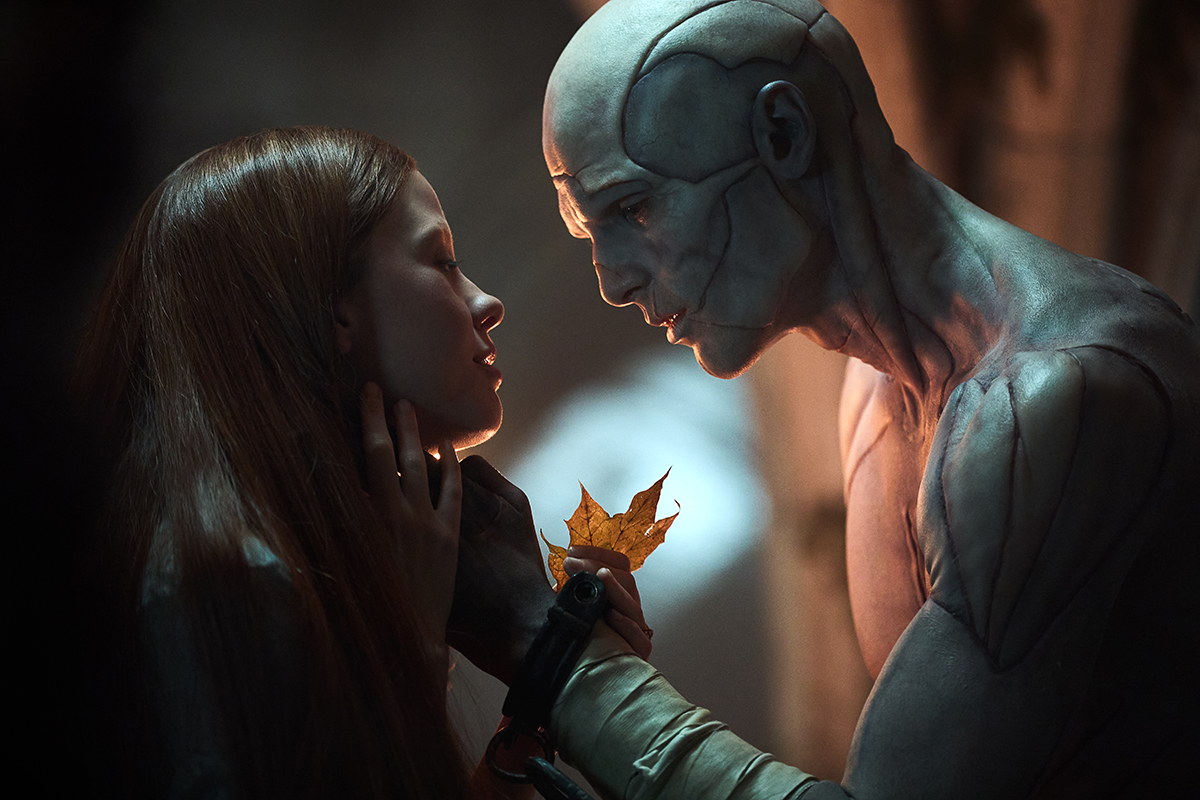
FRANKENSTEIN. (L to R) Mia Goth as Elizabeth and Jacob Elordi as The Creature in Frankenstein. Cr. Ken Woroner/Netflix © 2025.
Guillermo del Toro spent 50 years dreaming of Frankenstein. At age 11, the filmmaker began envisioning Victor (Oscar Isaac) and his creature, his son (Jacob Elordi). By the early 2000s, he finally started getting the film into development – but, for one reason or another, the project kept stalling until Netflix wrote del Toro and his team a fat check to make a grand horror epic.
“I’m happy it didn’t happen back then. It wouldn’t have the emotional charge that it has for me now. I felt a seismic change as a person making this movie,” del Toro now says.
The master filmmaker’s personal attachment to Frankenstein is thoroughly explored on the glorious Criterion 4K release of the Mary Shelley adaptation. On the bonus features, del Toro explained his vision with his signature passion.
Here are a few excerpts about the making of Frankenstein:
The Illustration
“In casting Jacob Elordi, I wanted very much to evoke… There’s a first illustrated edition of Frankenstein that was published in 1831. It resembles the actor Thomas Potter Cooke, who had the distinction of playing the creature for the first time – contemporary to Mary Shelley – in the theatrical adaptation. He also played Lord Ruthven, the first vampire. So, that makes him the first horror superstar, Thomas Potter Cooke. That illustration makes the creature beautiful: long hair, dark hair; pale; sort of crooked but ultimately, very beautiful and almost godlike. I wanted to cast somebody capable of looking like a child and looking like a man with soulful eyes, and the potential for rage. When I started to talk to Jacob Elordi, I realized that was in him.”
Modern Touches
“We tried to make her sophisticated without making her vain. [Costume designer] Kate Hawley was watching over that, so we get the idea she does have money and does have access, but ultimately, is not too exquisite. I remember Kate was worried Mia was moving too modern. She said there is a certain language, pace, and movement that comes with the wardrobe that guarantees period accuracy. I said I don’t want period accuracy. I said I want her to move like a modern woman would move, even if she has all those layers of wardrobe.”
A Nod to Hitchcock
“When I used to watch Hitchcock movies, I liked the way he puts the plight of the characters next to a giant mythical or grand symbol. You know, Mt. Rushmore scene in North by Northwest, the blackmailer escaping in the London museum against the giant Egyptian face, Norman Lloyd falling from the face in front of the Statue of Liberty in Saboteur. I think the panic and the pagan mythical quest Victor has is very well echoed in the Medusa head.”
It’s Alive, It’s Alive!
“Everything starts to go wrong. It’s the principle of the heist. In a bank heist movie, people plan the heist carefully, rehearse carefully, and then one by one, things go wrong…. It was important to make audiences feel they haven’t seen the scene. I knew there were scenes the audience needed, like they did on Pinocchio to identify the myth. For one, the creation scene…. In this movie, every opportunity we had, we would throw something at things going smoothly so they wouldn’t.”
Theaters of Loneliness and Nothingness
“One of the things I love about the book and do in the adaptation of the novel is the theater of loneliness. I wrote the final act of this movie like short plays. ‘Make one like me.’ Then there’s a short play of violence between them in the tent, with ‘You only listen when I hurt you.’ Unfortunately, that’s the relationship between fathers and sons. For that stage, you have to show nothing. It has to be a stage of nothing. A horizon, a sky, and snow. You see somebody going to the basics – a dialogue with himself, with nothing else around him. Victor and the creature are one and the same. The creature is Victor as a child. Victor is his father. We take them both to a landscape of nothing.”
