
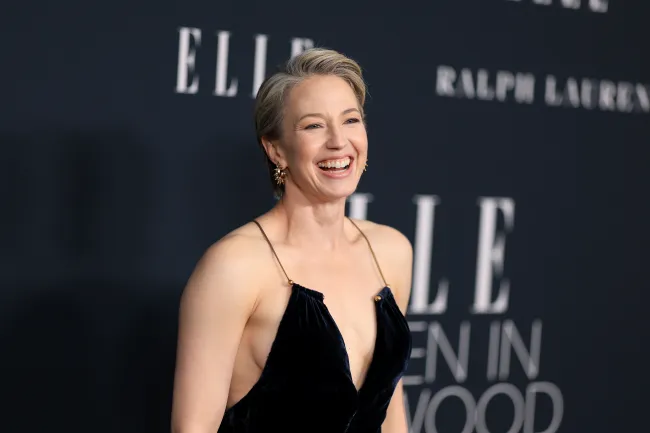
It’s hard to imagine, given her onscreen ubiquitousness in The White Lotus, The Gilded Age, The Leftovers, Gone Girl, to name but a few, but before The Liberation, Carrie Coon has only had one leading role in a film — in the little-seen The Nest, which got lost amid the chaos of COVID.
“So it means everything,” she tells Gold Derby, to finally get the chance to take center stage in The Liberation, Guy Nattiv’s very personal film about a Holocaust survivor named Rita Cooper, who leaves her family to join a commune led by Ricki (Lily James), a seductive cult leader. As audiences learn in the closing credits, the film is inspired by Nattiv’s own grandmother.

Known for playing strong, steely characters, Coon transforms herself physically and emotionally into the vulnerable Rita — in turn earning raves for her “finely tuned,” “breathtaking” performance.
Here, she opens up to Gold Derby about her frustration with the lack of leading roles for women, why she’s “always on the verge of quitting,” and why she thinks The Gilded Age‘s Bertha should become a suffragette.

Gold Derby: What does it mean to you to be in a leading role?
Carrie Coon: I don’t do it very often — not in film — so it means everything. You can make a movie and nobody will necessarily see it. I had that experience with The Nest, one of the only other leading roles I’ve had. It came out during COVID. It’s a beautiful Sean Durkin film with Jude Law, but almost nobody saw it that year. We weren’t able to promote it this way. So I feel very gratified to be doing screenings, participating in this week of the Governors Awards and meeting all the other women who have movies out this year. It’s been really satisfying.
Given how ubiquitous you are, it’s hard to imagine that you haven’t had a leading role before.
There aren’t that many movies made with women in them every year, so there’s not that much to go around.
That’s depressing.
It is, and it’s not changing. As Julianne Moore said a couple of weeks ago, we’re 52% of the population. We’re not a special-interest group. It doesn’t really make sense. We need to change that.
What drew you to this particular role?
I read the script and didn’t immediately see myself in the part, which is unusual. Normally, I either see myself in a role or I don’t, and that’s how I make a decision. But I took the meeting with Guy, and he told me the story of his grandmother. Then he sent me her testimony from Yad Vashem. I watched hours of it and became absolutely obsessed with her. I started watching many hours of other women from Poland, too. I just didn’t want anybody else to do it. I was sensitive to the fact that I’m not culturally Jewish, and I wanted to make sure Guy was choosing me because he thought I could do it — not because he was being forced to consider me for other reasons.
What did he say?
I can’t say it — I’m from the Midwest. [Laughs.] He was very complimentary. He said he thought I was one of the greatest actors of my generation, that he’d been following my career for a long time and believed I could do it. He wanted to see me do something more fragile. He’d seen me play strong characters a lot and was interested in my fragility.

You often play strong characters, like Bertha on The Gilded Age. How did you approach the more vulnerable side of Rita?
It’s inside me; I just haven’t done it on screen. It’s in the script. What I love about the script is that it takes the reader on a journey. There’s nothing simple about the decision-making, and there’s no villain in the story of Guy’s family. His grandmother is the villain, right? The film complicates that story. There’s a lot of compassion for her, and I found so many layers in how she ends up where she does at the end of the film.
Then you have Lily James playing a female cult leader who is also very human and charismatic — not overtly evil in any way. To have two really complex female characters at the center of a film that actually gets made is astonishing.
You undergo an incredible physical transformation. How did that help you find the character?
I got the role only a few weeks before we started shooting, so I didn’t have much time. I immediately got together with a nutritionist. I’d been meaning to do that anyway because I’m a mother of small children, and I knew my diet wasn’t working for me. Eating the crusts of sandwiches wasn’t getting me through.
I started to lose weight. We had hoped and planned to shoot in order, but Lily’s schedule meant we had to start with the family and bank material, move into the cult, and then come back. We also knew we needed a wig because they had to cut my hair. I agreed to cut it, of course — why not? It was a lovely invitation to transform. I called my Gilded Age team, borrowed a wig from them, and took it to Vancouver. We fashioned it the day before we started shooting, and suddenly we were in the bank.
After playing Rita with the heaviness I experienced in those testimonies — and then going through the opening she experiences in the cult — going back into that body later was so uncomfortable. We had to pad me back up. I hadn’t lost that much weight, but it was noticeable.
That’s a lot to put yourself through.
I love that. I want to be invited to use my body. Men are always invited to do that. Most male characters use a man fully, but female characters don’t always give us that experience. We’re not invited to use ourselves vigorously. That’s why I like theater: my whole body signifies in space, and I’m not invited to do that as much in film.
I love the vigor. I love scenes like the one in The White Lotus when I have to hang out of a window. That’s my favorite day. I love the days when I’m in the rain machine, falling down and putting my face in the dirt. Those are my favorite days at work.
Speaking of using your body, tell me about the dancing scenes.
I love those. I’m not known for being physically inhibited; my other dance scenes on film probably demonstrate that. The challenge in the first scene was playing Rita’s restraint.
I thought about my own grandmother, a conservative Catholic housewife in Ohio with four children. She had a very traditional household, raised her kids and then was very hands-off with her grandchildren. I couldn’t imagine her being in a room with women, being invited to disclose something personal, and then being with someone like Lily in that moment — with that level of freedom and an invitation to move her body. Getting my grandma to dance at a wedding was very hard. I tried to channel Grandma Rosemary.
We also had a wonderful choreographer, Heather. She watched the first take, which probably could have landed me straight on SNL. The producers came out and said, “We’ve never seen anything quite like that before.” Heather would point things out: “Let’s pretend your ribs are attached to your hips; they’re not separate. And remember, if you make a big move, you’re really ashamed.” She noticed things and then dialed up what was useful. We got through a couple of takes, and then they did that beautiful edit.
Lily is so earthy and sensual in contrast. You feel the pull of it unfolding physically in space, which is always useful in a visual medium like film.
Since Rita goes through such a transformation, how did you calibrate your performance?
A lot of the moments in the cult were shot in order, I’m sure, as you know. Things are rarely shot in order anymore. I think I shot material from three episodes on my first day on The Gilded Age set; I had no idea where we were in the story. This was a little more chronological.
There’s something useful about dealing with what happened the day before without having experienced what’s coming next. A chronology unfolds as you process things in the moment. Otherwise, you have to rely on your scene partners to get you there. Going backwards was uncomfortable. We shot the Holocaust testimony — the breakdown scene — last. It was our final day of work.
There was a beautiful symmetry in returning to where the story started for Guy, the filmmaker, and his wife, Jamie [Ray Newman], his producing partner. They were very emotional that day because some details were pulled directly from his grandmother’s testimony. That testimony was the jumping-off point for the whole story. It was a profound way to finish the film, even though it was out of order.
What responsibility did you feel in playing someone who meant so much to Guy?
Thankfully, it’s fiction. The character is based on his grandmother, so I wasn’t really playing his grandmother, which he was always quick to remind me. He gave Lily and me a lot of latitude to build the character. He was also generous when he felt Rita was present in the film in the way he’d hoped, or when something felt truthful in its emotional content, even if it was adjacent to the story.
He was generous about sharing what he was going through. A director could feel compelled to mask that or withhold it from the actors, but he was always emotionally present with us. That gave me confidence that we were finding the essence of his grandmother, even though it wasn’t his grandmother.
Ultimately, I felt the most responsibility to Rita, knowing that she may have been misunderstood or cast in a particular role in the family, when the life she lived after she left was rich and unusual. She felt so compelled to leave that I think she would have died had she not. It was important to dignify her journey and demonstrate Guy’s compassion as he reexamined the family history. I wanted audiences to leave not simply judging her, but contemplating not only the fact that a woman left her family, but why more of us don’t leave circumstances that aren’t serving us.
How did you come to understand why she left?
I’m a wife, a mother, and I work. The cognitive load of motherhood is very high. I don’t know a mother in my life who hasn’t woken up one morning and thought, “Well, I could just leave. What if I just leave?” It’s a fantasy. I’m not going to leave my children — I love them. I have a really healthy, egalitarian marriage. My husband [Tracy Letts] took care of our kids for six months while I was in Thailand, with help, of course.
But I feel the way we raise children isn’t helpful. It’s very isolating, and I don’t think it’s how we’re intended to do it. The village is real, but now we’re alone in the suburbs, alone in our houses, expected to be everything to our children and husbands and somehow take care of ourselves, too. I think it’s impossible, and I think it’s intentional. Keeping women isolated keeps us powerless. There’s a bigger story being told in that isolation.
We shouldn’t be denied self-actualization because of that — because of patriarchal, perhaps even fascist, pressure to keep us apart. It feels really political. Rita feels entirely radical to me for having done what she did. Of course, she didn’t leave her babies; she left her grown daughters, who were going off to college. They were leaving her. She was expected to sit there and play out this made-up story about what a wife and mother does when her children are gone. What’s fair about that?
I understand why she left. Who are we to say what somebody needs in order to heal? Her trauma was profound and specific, but also personal. We don’t get to decide for someone else how they move through trauma. Guy would be the first to say that he believes this woman prolonged his grandmother’s life and that she achieved physical freedom. She also unlocked her voice. She wasn’t able to give her testimony until she’d been in the cult for some time; she couldn’t tell that story before. She got something out of it, and I think that’s undeniable.
Do you think her trauma from the Holocaust made her susceptible to the cult?
Entirely. She lost her childhood and her mother. Then here comes a woman offering dancing, companionship, belonging, silliness and singing. Of course she wanted to reclaim a piece of that childhood. Of course she imbued a woman with a maternal role in her life. When you create a mother, it’s easy to cede agency to that mother.
She returns herself to a very childlike state, so the ending becomes inevitable. Rita believes what she’s experiencing is unconditional love, but it isn’t. Of course she goes back thinking she can have it both ways.
There’s also so much survivor’s guilt. Those people weren’t given tools to deal with what they experienced. Many Holocaust survivors experienced severe depression; some died by suicide. Some didn’t express what had happened to them at all. That’s why the testimonies are so important. Having repositories of stories is critical to holding that memory for humanity, which is unfortunately doomed to repeat it.
It can’t be lost on anyone that when she passed away, she looked as if she’d walked out of a concentration camp. I can’t help seeing, subconsciously, a desire to punish herself for surviving. I think that’s in there, too.
She also found joy with Ricki. I’m thinking of the roller-skating scene.
I love that scene. It’s really important in the movie. I remember doing it and thinking, “Oh, this is in here, too.” There’s joy and color in the movie. Her family sees her opening up and thinks maybe it isn’t so bad. It’s also the beginning of the love story, because it’s fundamentally a love story.
What Rita found with Ricki was companionship, a love relationship, a sexual relationship, desire, novelty — really life-giving things. I love that the scene is in the film. You see in Lily’s performance the vulnerability Ricki has and how invested she is in the relationship. She stands to lose something when Rita leaves.
You see the roller-skating scene and then, later, the scene when Rita is about to take her girls. It’s a breakup scene, which I didn’t realize until we did it.
What was it like filming the scene in which the two women face off?
Lily is always looking for the truth. If something feels false, she’s uncomfortable, and she keeps digging until she figures out what her action is in the moment. I remember her gathering all the things she needed to make tea and using that sequence of actions to punctuate her argument to Rita. She felt so alive in that scene.
Rita had imbued her with so much power, so I got to experience being afraid of her — afraid of the consequences of the decision. It was one of those scenes where you’re in it and also admiring the person you’re working with. That’s the weird thing about acting: there’s always a dual consciousness. You like to think you’re 100% present, but I’m sure that’s rarely true. It’s ephemeral and hard to unpack; when we try, it falls apart. But I remember admiring Lily’s conviction and capacity in that moment.
One disquieting thing is realizing that Rita still loves her girls. When they arrive at the camp, she’s genuinely happy to see them, even though she’s still in that cult state of mind.
Yes. She sent the postcard and the information, not knowing if they would come. She’s in trouble for having done it; she broke a rule. In the state she’s in, constantly looking for permission, that was some validation of the essential person still inside her.
Of course she still loves her girls. If we’ve prepared our children for the world, there will come a time when they leave. That’s our responsibility. It doesn’t mean we sit at home like a potted plant and wait for them to bring home laundry. It’s OK to go out and seek something healthy. She happened to find something aberrant, but I wouldn’t fault any woman for seeking herself.
It’s easy to be subsumed by motherhood. It’s one of the most profound creative acts a woman can undertake. I find it’s made me a better, more empathetic artist. Maybe it’s given me less time to work and prepare, but perhaps it makes me available in a different way — or helps me worry about the wrong things less. Maybe there’s freedom in that, or efficiency. Maybe it’s just efficiency.
I’m so grateful to have children. But I remember turning to Tracy right before his three daughters came my way. We were in a particularly difficult time with sleep, I think, and I told him, “I can’t do this anymore. I can’t do both things well. I think I really need to take a step back.” Then Jacob showed up on my doorstep with the script, and Tracy said, “You have to do this one, and we’ll figure it out. We’re going to find you some time. It’s only a 14-day shoot.”
I’m always on the edge of quitting.
Please don’t.
Hopefully, with a movie like this in the world, people can see me in a new way and new opportunities will come. Actors want to act. Everything we do to encourage people to see our movies is so we can keep doing the thing we love. And now I can’t really do anything else.
Talk about filming the scene where you leave your daughters, played by Bella Ramsey and Odessa Young, in the hospital.
That scene was emotional for me because I’d been away from my kids for several weeks. They were with me for the first few weeks in Vancouver, which was very hard — co-sleeping with my kids while trying to get enough rest to work the next day. But I could lean into my tired-mom body in those scenes.
By the time we filmed that scene, we’d been apart for perhaps three weeks. I really missed my kids, and I could open myself up to that longing. But the scene plays out in Bella Ramsey’s face. It’s really Bella’s moment, and Bella is an extraordinary actor. They’re so energetically available and can access a deep well immediately. It feels so alive; you don’t know what Bella is going to do with that energy. It can be cagey and exciting.
I was far from Bella when we shot that moment. When I saw the close-up, it was devastating. Bella really broke my heart in the phone call with Tracy, when their character, Ella, masks her emotions for her dad. That was the maturity of it — the heartbreak. For me, in the car driving away, it was simply: “Why don’t you go ahead and miss your kids? Really miss them.” That’s what you do.
What was it like having Tracy in the film with you?
I knew what I was getting. Tracy’s a great ensemble actor, and he’s my greatest fan. He has no ego. He knows what a supporting part means and knew he was coming in to support his wife. That doesn’t bother him.
He came to set and immediately started getting to know Odessa and Bella, building the intimacy so the family felt lived-in. What I love about the film is that Rita’s situation isn’t bad; it’s a good life, and they enjoy one another. The marriage is pretty good. They laugh and smoke cigarettes together. You see what Rita loses and what they lose by losing her. It’s not someone leaving something bad to do something worse.
Tracy and I have been married for 15 years, so we can get in there and yell at each other with no consequences. You feel safe in a marriage; you can yell and no one’s leaving. He’s really scary, too, which is fun. Lily was genuinely physically startled by him when he yelled or hit a doorframe, and she talked about how useful that feeling was. Seeing Ricki feel thrown is an important color in the performance. Tracy brings fear and terror to those moments, but also great vulnerability. He’s heartbreaking when he’s trying to get Rita to stay.
The part was small enough that I was working with the assistant director to get him out of there with the kids so I could concentrate on the movie. It was nice to know he’d travel back with them and take good care of them while I worked.
He’s the greatest. Some actors have to tell you all the work they’ve done. Tracy comes in and asks everyone questions. All the women fall in love with him because he wants to know their stories. By the end of his shoot, he knows everyone’s story. That’s the kind of guy Tracy is.
What did you take away from the experience of making this film?
What I find most unsettling about the film, and worthy of contemplation, is that the simple response is to ask, “Why would a woman ever leave her children?” The bigger question is that we’re all living according to social rules that are entirely fabricated. They’re not real at all; it’s pure tacit agreement. And every day we wake up and keep doing it.
What’s unsettling is to contemplate the possibility of not doing that anymore, or to ask yourself why you’re still doing it. To get into that unfillable hole and find out what’s filling it is a worthy exploration — one we’d all do well to sit with, given social media, political tribalism and our ability to ignore the extremity of the situation we’re in as a species, and what we’re doing to the planet.
Is it harder to play a character like Rita or one like Bertha?
None of it is hard. It’s all delightful. It’s like turning the dials: What part of yourself do you turn up? What part do you turn down? What part do you have to look for and find? It’s all really fun. I want to do all of it.
What’s next for Bertha? What would you like to see for her?
I imagine Bertha will be a suffragette now. Nobody knows yet what happens at the end of the season. The critics know — you’ve seen all the episodes — but I’d love to see the relationship between her and Gladys grow. That mother-daughter relationship and their mutual respect are really interesting to me. Morgan [Spector] and I are pitching that Bertha and George just decide to become philanthropists and go on a European tour. We’d see them go from city to city buying things and let the kids have all the drama back home.
We’re here for it.
