
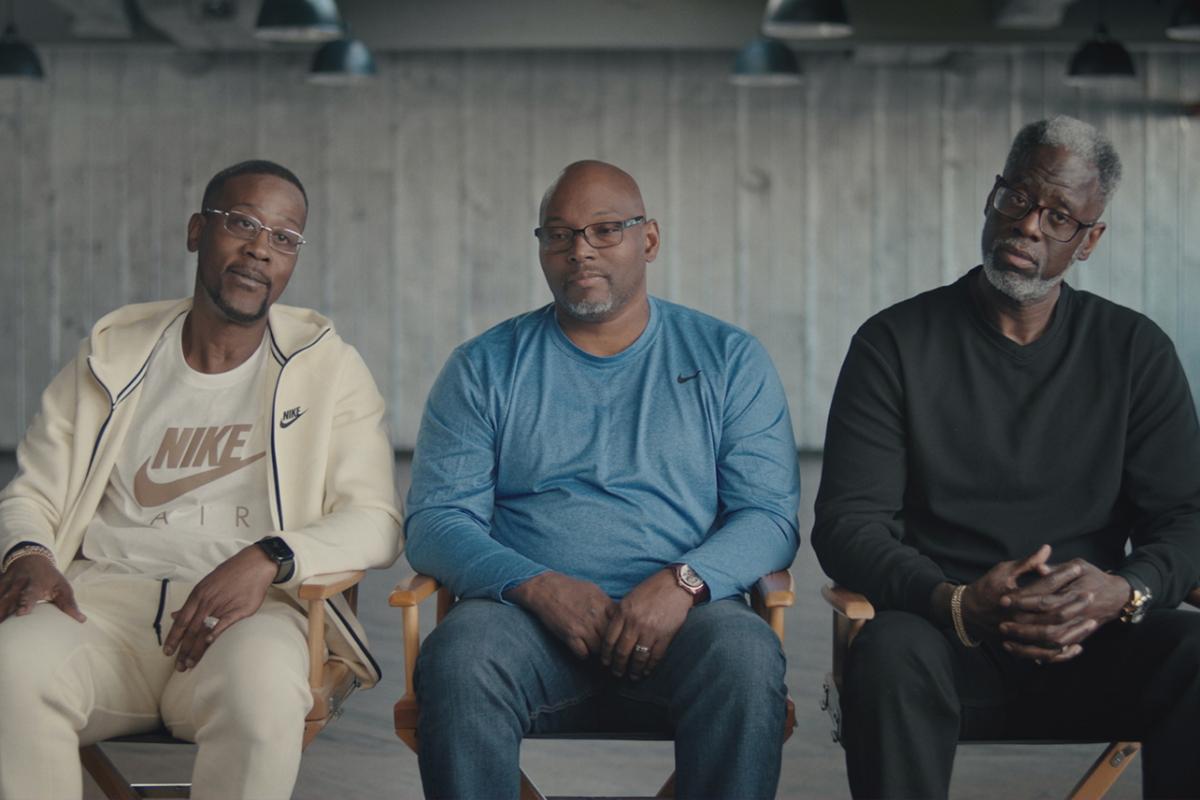
When a Witness Recants (now on HBO Max) presents a new wrinkle to its true-crime-adjacent documentary formula. Director Dawn Porter interviews the principals of the story of the Harlem Park Three, a trio of Baltimore men wrongfully convicted of murder in 1983 and exonerated after 36 years in prison. But while most docs wrap with the saga’s latest development, this one stages a fascinating final act that brings the title into sharp focus.
The Gist: Writer Ta-Nehisi Coates, also a key producer behind Recants, shares how the sense of community and security he felt while growing up in Baltimore changed after teenagers Andrew Stewart, Ransom Watkins, and Alfred Chestnut were convicted for murdering 14-year-old DeWitt Duckett in 1983. Duckett was walking the halls of his junior high with friends Ron Bishop and Edward Capers when a gunman shot him, stealing his then-chic satin Georgetown jacket. Please note gunman, singular. Stewart, Watkins and Chestnut had visited the school moments earlier for benign reasons; the building’s 87 doors (!) were unlocked, and the boys were escorted out by a security guard.
It was a high-profile story. So high profile, the police felt significant pressure to catch the perpetrator. To be blunt, police detective Donald Kincaid’s was a shitshow and a travesty. For reasons unexplained, he was dead-set on nailing Stewart, Watkins, and Chestnut despite significant physical evidence and eyewitness accounts to the contrary. He coerced false testimony from Bishop and Capers, who were 14 years old, cross-examined without lawyers or any other adults present. The prosecutor suppressed evidence. The judge overlooked gross inconsistencies and vague testimonies. The public defender was exasperated. A jury declared the three boys guilty, and they were given life sentences.

Porter works through this upsetting saga, including its somewhat-happy almost-ending when the trio were released in 2019. Stewart, Watkins, and Chestnut participate in the doc, sharing their struggles bravely and openly — and so does Bishop, who has wrestled with his role in this travesty for decades. Also included is archival footage of Kincaid, Coates, and others, depositions from a 2022 civil case against the Baltimore Police Dept. that awarded the Harlem Park Three $48 million. Their release from prison is a moment of relief and joy. But there’s 30 minutes of the documentary left, reserved primarily for a sit-down with Stewart, Watkins, Chestnut, and Bishop. But closure is not so easy to come by.
What Movies Will It Remind You Of? The subject matter is similar to the Paradise Lost films, a trio of docs about the wrongful conviction of the West Memphis Three.

Our Take: When a Witness Recants is devastating in many familiar ways, whether it’s from the emotional and psychological trauma these three men carry, or the crass corruption of the justice system and the people within it. Kincaid, only seen in 2022 testimony, is the unrepentant villain, capable of remembering details of his investigation until he “can’t recall” anything that might reveal his obvious malfeasance. The lack of a hard and fast reason — beyond external pressure to solve the case — for railroading these men is infuriating; the struggles of Stewart, Chestnut and Watkins, as children sent to a federal penitentiary and as grown men dealing with devastating loss, are heartbreaking.
Porter’s approach to the core journalistic narrative is concise and satisfyingly detailed. But it’s contrasted, effectively and fascinatingly, by the messy emotions on display during the film’s final stretch. Bishop is the witness of the film title, and he’s a complex, almost mercurial character throughout. Porter treats the Harlem Park Three with the sensitivity and respect they deserve, while also diligently probing Bishop’s psychologically fraught experience. The result is a revealing expose of the spectrum of the human condition. We reach the end of the doc hoping for and anticipating warm fuzzies, and we don’t get it. Such is life.
Our Call: Must-see documentary. STREAM IT.
John Serba is a freelance film critic from Grand Rapids, Michigan. Werner Herzog hugged him once.
