
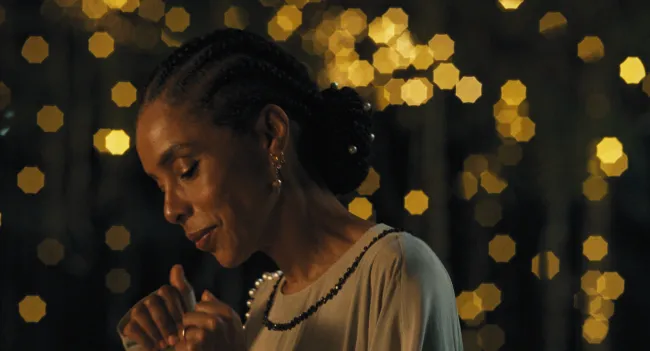
When transplanting Virginia Woolf’s novel Mrs. Dalloway from London to Lagos, Nigeria, in their film Clarissa, sibling directors Arie Esiri and Chuko Esiri were struck by “the human element, the human story, the idea of the nostalgia of youth and of being worn down by society and systems,” and how those themes translated to a different cultural context. “That’s what happens in life,” Chuko explains. “You get older and society tells you you have to behave in a certain way.”
Clarissa follows the title character (played by Sophie Okonedo) as she prepares for a party that reunites old friends and lovers. Through flashbacks, we see her at a younger, more idealistic age (played by India Amarteifio). And along the way her story intersects with a soldier, Septimus (played by Fortune Nwafor), who has been traumatized by events during his service.

The film premiered in the Directors’ Fortnight section at the 2026 Cannes Film Festival before its fall U.S. premiere at the New York Film Festival, and most recently it earned four Gotham Award nominations. The awards buzz has been “surreal, especially when you think of a film from Nigeria, telling a very Nigerian story, reaching so many people,” says Chuko. Arie is “not surprised” by the attention Okonedo’s lead performance has garnered, but “now for [the film] to have this kind of life is just something I hadn’t imagined.” Chuko adds that the acclaim is “icing on the cake, icing on a very big cake.”
Read on for our full Q&A with the Esiri brothers.
Gold Derby: Clarissa is based on Virginia Woolf’s novel Mrs. Dalloway. What about the book resonated with you on a personal level?
Chuko Esiri: For me, it’s a book that I’ve read dozens of times, and will probably read another dozen or so times before I finish this life. I read it when I was like 17. And I always say that I hadn’t read anything like it before. And I didn’t understand it, but I felt it. I think the closest I can say is the way she writes her prose, how fluid and disjointed and how rich it is, felt a lot like the noise in my head. So it’s just a book that has lived with me.
And then I was rereading it again like nine-ish years ago. And now I understood it, right? I’d had some life experience. And it also wasn’t lost on me that Clarissa Dalloway, the person, and our home country, Nigeria, were about the same age and were also going through this phase of what happened to all the promise — of independence in the case of the country, of youth in Clarissa’s case. And all that stuff was pinging around in my head. And I always write to an answer. I don’t go in with a clear road map or plan.
But I always feel, even just in my own personal life, keeping journals and stuff, if I have this feeling of confusion, or I want to make my thoughts clear, I always have to write. And that was sort of the thing with the book. It was just staying with me and staying with me. The characters were staying with me. And so I just started writing and I ended up with a script.
Arie Esiri: I’m here by dint of Chuko’s fervent passion for Virginia Woolf and the novel. And I think Chuko had also already committed to the idea of adapting this fairly early on, before I had the chance to read the book or discover it of my own accord. But I’ve obviously grown to absolutely love it. I had the great privilege of being patient enough to wait to read the script before I read the novel. And it was just such a wonderful way to enter the world through Chuko’s lens. And yeah, I have since been revisiting the novel post-shooting. She’s a very visual writer. I’m a very visual person. And a lot of her prose informed a lot of the visual approach to the film and inspirations.
What elements of Mrs. Dalloway did you feel would translate well to modern-day Lagos?
Chuko Esiri: Well, I think the human element, the human story, the idea of the nostalgia of youth and of being worn down by society and systems. And it’s especially unique in Nigeria because we have a colonial history. So there’s an extra weight. That’s what happens in life. You get older and society tells you you have to behave in a certain way. And there are all these rules, all these social orders we’ve created. And in the case of Nigeria, it’s one that’s been inherited. So it kind of doesn’t fit with the individuals. And I think it’s always a bit more damaging personally.
So it was mainly that, but principally, I think it was just the human emotion of wanting to dream and wanting to have a big, beautiful life and just being worn down by responsibilities, by the people around you, and learning to deal with that.
The story was originally set in London, the home of the colonizer, and now you’ve taken it to Nigeria, which was colonized. How do you think that affects the narrative, if at all?
Chuko Esiri: The book has anti-imperialist undertones to it, but it’s not a very ardent criticism or a very strong representation of how deleterious imperialism is. And I think setting it in Nigeria, that was a thing that we were able to bring further forward. You see it in how they behave in the household, how they relate to one another, how society is very much structured in a very kind of British way, an upstairs/downstairs form. So I think that was a thing that we were really able to lean into and examine a bit more than the book does.
Tell me about translating the stream-of-consciousness rhythms of Virginia Woolf’s text into cinematic form. What would you say helped you create that onscreen?
Arie Esiri: I think a lot of the silences and the imagery. I feel like the images have a lyrical quality to them. And also how we deal with temporality through the edits — we tried to make it feel as seamless as possible weaving between the past and the present in both the lives of Septimus and Clarissa. That in itself was a real challenge, trying to figure out how to do that in the least confusing way possible.
But we’ve been saying, to those that have struggled with not having timestamps and all those sorts of things, that the novel is far less forgiving than our adaptation. But it was mainly that and mainly thinking about whose head we were in, the past as fact and past as memory. These are all things that we’re juggling to tell a story that felt both linear and fluid.
You worked with casting director Nina Gold to put this cast together, and you have younger and older versions of the characters that have to correspond to each other in a way that feels natural and comes across to the audience clearly. How did you go about finding those actors and directing them to play the same person?
Arie Esiri: Well, in all honesty, a lot of that was on Nina. Nina went in with the mandate of trying to cast for essence and not for physical attributes. It was important for the older and younger versions of the characters to have the same essence, but not necessarily look alike. So it was this weird game of whichever version was cast first, there was the challenge of finding the other version. So Sophie [Okonedo] was one of the earliest people to be attached to the project. And then the next person was Ayo [Edebiri]. So in both instances, we’ve got to find the older version of Ayo, we’ve got to find the younger version of Sophie. And Nina, who has such a huge Rolodex of actors, specifically in the U.K., was instrumental in building those protagonists.
But once we got to Nigeria, she worked with a casting associate, but also came and did a whole bunch of the local casting as well. And there we were a little bit freer, especially with Septimus, because they’re the same actors. So with that, we were just looking for the strongest performers and people that worked well together on screen.

Chuko Esiri: I think with directing the same people, like Arie said, the work was really done when Nina cast individuals that felt like the same person, because who you are in your 20s is drastically different from who you are in your 50s. So some of the actors spoke to each other. I know David [Oyelowo] and Toheeb [Jimoh] spoke to each other because they were thinking about how they would play with the penknife. They had a physical prop, and they discussed the ways in which he would fidget with it that would probably carry through, that would probably be the same from when you’re young into middle age.
But for us, it’s different because it’s different stages of life. The actors were free to go ahead and to play the scenes and to play the emotions of those moments. I will say we did shoot the older, present-day period first, before we shot them in youth. And it was a completely happy accident. Because the younger actors weren’t there, we did a table read, and the older actors read the younger parts. And that ended up being something very useful for them, because they had played themselves in youth, and they carried that into their performances. But it wasn’t a thing we had planned. It was a fortunate blessing.

It’s also a visually beautiful film. Tell me how you worked with cinematographer Jonathan Bloom to develop the visual style.
Arie Esiri: Well, Jonathan was my first ever mentor in film. I originally wanted to be a cinematographer. I had worked on sets doing a whole bunch of other things, but some of the first sets I was on from a camera POV, getting to see what the camera department did or how that functioned, were Jonathan’s sets. So I’ve had an ongoing working relationship with him for several years. He also happens to be a family member. He’s married to my cousin.
So I feel like we have talked about making this kind of film one day together, and are both really interested in classical forms, or classical types of films. So the working relationship was really seamless. But we did go in with the ambition of making something that felt timeless, that had a strong sense of nostalgia and beauty to it, but could also reflect the environments that we were shooting, particularly with the North. The North we wanted to make beautiful, but stark at the same time. So we referenced a lot of 19th-century Scandinavian paintings.
We also talked about how we wanted to approach all the different stages of the film. In the past, we shot with longer lenses and made it feel like a warm, beautiful memory. The present we shot in a real present sort of state: we were with the characters closer, and the camera’s telling the truth there. And then we had a sort of mixture of the two for Septimus’ storyline.

What would you say the biggest challenges were in taking the story and translating it, from a writing and a directing standpoint?
Chuko Esiri: I think with the writing, it was organizing and figuring out the structure, because the advantage London has over Lagos is that London’s a pedestrian-friendly city, whereas Lagos isn’t. And so much of the book is her walking around London, and Septimus as well. It’s so much of them in shared spaces, the park and down Piccadilly. You get a stronger sense of their different experiences, because they’re sharing the literal same spaces.
Whereas we didn’t have that advantage in Lagos. So for me anyway, writing was a challenge of seamlessly weaving Septimus into Clarissa’s world in the same way, or close to how it is in the book, which is what led to them actually meeting and occupying the same space, which doesn’t happen in the novel. But that was the greatest challenge: how do I bring his world and his life into hers in a way that helps to reinforce and to shed a stronger light on the various themes and issues that we were trying to touch on in the film.
Through Septimus, instead of the British Army, you’re exploring the Nigerian army and the trauma he experiences there. What was it like bringing that to the film?
Chuko Esiri: I think it was important, is the only word that comes up. Nigeria’s governmental institutions are the places that have suffered the most from a very long line of abuses extending back to the colonial era. So it felt like the simplest way to directly show the audience what most people are up against when it comes to living at home, specifically because he’s supposed to be fighting to protect the nation, but he’s not getting the tools he needs, he’s not getting the support he needs, and he’s really without a safety net. That’s what happens in these places when you’re failed. So it was a story we held quite near and dear to us. Thinking about our work with our first feature as well, it also felt like the most familiar space.
Arie Esiri: That storyline gives us the opportunity to reckon with the complicated political aspects of the country, and to confront them and weave them into this discussion. Otherwise, it would just be parties and frivolous conversations.

The film is getting awards buzz, including for Sophie Okonedo’s performance. And what’s interesting is that we have an Academy that has gradually been getting a little younger and more internationally diverse. How does it feel to be in that conversation with this film in this particular season?
Arie Esiri: Surprising. It has been wonderful.
Chuko Esiri: It’s honestly just surreal, especially when you think of a film from Nigeria, telling a very Nigerian story, reaching so many people. And obviously, for Sophie, I always say she’s one of the great actors of our generation. And for her to be in that position, and to be getting her recognition, feels long overdue in a strange way. So we’re completely ecstatic and excited, and that she’s getting all of that praise and recognition—
Arie Esiri: That I’m not surprised by. But just the fact that we’re here — honestly, I remember maybe on the second day saying, “I’ve just got to survive this thing shot for shot.” So every shot is like, do we survive that shot and just move on to the next one?
I think when you’re making films in particular, you’re only ever looking at the problem that’s right in front of you. And it can be really hard to see or imagine what the tail of a film might be, at least for me. So to just have made it through production, and just feel so proud and pleased that everyone had a great time and we all made something that felt good, was amazing. But now for it to have this kind of life is just something I hadn’t imagined.
Chuko Esiri: Icing on the cake, icing on a very big cake.
