
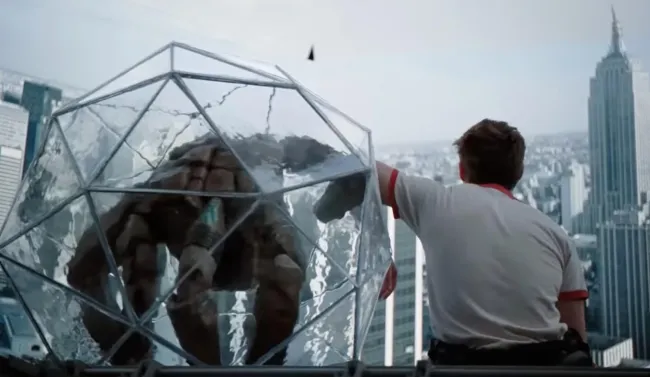
Rocky the alien worried Daniel Pemberton.
“I did The Dark Crystal for Netflix, and so much emotion came through the eyes of the puppets,” the composer says. “So when I was told we had a character with no eyes, no facial features whatsoever, I thought: this could be a complete disaster.”
Pemberton, an Emmy winner, newly minted Grammy nominee, former Oscar nominee, and a regular Phil Lord and Christopher Miller collaborator since the Spider-Verse films, joined Project Hail Mary before shooting began and did everything in his power to avoid disaster. The composer wrote temp pieces for Ryan Gosling to listen to on set. He crafted what he calls “an entire orchestra from scratch,” from a friend’s squeaky bathroom tap to a rare 1950s instrument to a class of schoolchildren stomping in unison at Abbey Road studios. Rather than the usual sweeping space-opera sound, Pemberton’s goal was to build something “radically different from anything you might have heard in sci-fi before.”


There was one other way this score differed from anything Pemberton attempted before; Lord and Miller wanted buddy music. “If someone asks me for chase music or horror music, I can do that,” Pemberton says. “Buddy music — especially between a man and a rock? That’s genuinely challenging.” But Pemberton delivered in a memorable way and created an exceptional musical vocabulary for Rocky, evolving from the percussive “Erratic Maneuver Detected” to the bouncy, near-tropical “Amaze Amaze Amaze.”
Audiences can’t get enough of the film or the score. This Friday, Pemberton will lead a live-to-screen performance of the film at Hollywood’s Dolby Theatre, featuring a 70-piece orchestra and full choir — a one-night-only show that sold out in seven minutes.
In this deep-dive interview with Gold Derby, Pemberton explains how that squeaky tap cracked the score and why “Time Go Fishing” never lets the audience off the hook. He also breaks down the soundtrack’s most-streamed cues and reveals why making people cry is his “favorite thing.”

Gold Derby: I know you have a long history with Phil and Chris from the Spider-Verse movies. I assume you were on speed dial when they decided to do Project Hail Mary?
Daniel Pemberton: I like to think it’s not a speed dial. It’s more like a Morse code message being sent out across the ether. We talked about it a lot. I got involved very early, before they even started shooting, and ended up going on set and writing some pieces for Ryan to listen to while he was filming. But Project Hail Mary was like trying to discover a country without a map. Very exciting, but sort of terrifying at the same time.
In what way? Was it the epic scope of the film, the fact that there was so much music involved?
We were trying to build something from the ground up that felt radically different from anything you might have heard in sci-fi before. But we didn’t know what that was. I didn’t know what it was. They didn’t know what it was. And when you try to do something that feels different, it’s millions of times more complicated than doing something where you know the parameters. Whereas here, everything from the language of the music to how it sounds and how it interacts was a huge undertaking.

And then there’s the nature of the film itself: at the end of the day, it’s really just Ryan Gosling on a spaceship talking to a puppet rock with no facial features. Creating whole other narratives and feelings alongside his amazing performance — and James Ortiz‘s — was a daunting challenge. Trying to make that feel hugely cinematic through the score, and through Greig [Fraser]’s amazing cinematography and the production design — that was the core challenge.
I was talking to [creature designer] Neal Scanlan, and he told me it took months before they could perfect Rocky — this thing you hadn’t seen before, but something you could identify with and believe to be interacting with Ryan Gosling. I’m curious about your parallel journey. What eventually cracked the code for you? Was there a specific cue, a specific feeling, a scene where you thought, “OK, I think we’ve got it?”
Weirdly, it was my friend’s squeaky tap. I was staying at a friend’s house in the countryside — a very old house — and his bathroom tap made this terrible noise. I went back and recorded it on my iPhone, then sampled it and turned it into an instrument. This horrible noise became something beautiful. It had what I’d been searching for: an etherealness, but also an organicness.
Watch Daniel Pemberton show the squeaky tap that unlocked his Project Hail Mary score:
A lot of this score is about organic matter — how the world of nature is, in some ways, quite imperfect. There’s a chaos in the universe, and I wanted to capture that in the sound. So I started using instruments that were very tactile — wood blocks, steel drums — things where you could feel texture in the music. But it wasn’t until I found that squeaky tap that I felt I’d found the magical ingredient.
I then started doubling it with an instrument called the Cristal Baschet — a very rare instrument made in the 1950s by the Baschet brothers. It’s made of glass rods, like a chromatic piano, but you play them with wet fingers, and that pushes sound through metal sculptures that act as speakers. An insanely otherworldly sound. I started blending those, and that was my way in.
From there we went on a huge amount of discovery. The biggest addition was the human voice and body. Phil and Chris and I talked a lot about what the film meant — about what Grace represents. He represents humanity, the last human alive, and we wanted to find a connection back to Earth. The voice was the way to do that, especially since so much of this film is about communication. I also used the body as percussion. I had a whole class of school kids bused into Abbey Road, and they were doing all this incredible stuff playing their bodies — because I wanted as much human touch and feel in the film as possible. And since Grace is a teacher, I loved the idea of getting a class of kids in.

The score is really something special and different. The film makes visual reference to the classic sci-fi canon — Alien, Spielberg, Star Wars, 2001 — but the score doesn’t sound like any of those.
One of the things that made this extra challenging from a composing point of view is that all those films you’ve mentioned are very serious. Trying to balance the lightness and the humor in Project Hail Mary, alongside the awe and the majesty and the scale, while still keeping a sound that feels cohesive — that was very complicated. Humor is hard.
Could you talk a little about your relationship with Phil and Chris? Do they basically give you free rein to explore, and then you go back to them and it’s yay or nay? How does the collaboration work?
It starts off with a lot of conversations. One of the best things about Phil and Chris is they are 100% dedicated to doing something new, and they push everyone around them to do the same. I’d write things early and start feeding them in, and once they started editing, those ideas would find their way into cuts. Sometimes they’d take tracks just to get a vibe; other times I’d write whole new things based on the edit. There’s so much back and forth — so much. To the extent that I pretty much ended up living in the room next to their edit suite in Los Angeles.

I liken it to climbing a mountain. I can sort of see a path. But sometimes they’re like, “Why don’t we go that way?” And I’m like, “I think the path is this way.” And they say, “Yeah, but what happens if we go that way?” Sometimes you do, and it’s really great — you find a new path. Other times you go back and realize there’s nothing that way. It’s full of bracken.
The film is set in space. There are basically two characters on screen. There’s a lot of music to fill. When you were mapping this out, did you know where it was going to be score and where they’d planned needle drops? Did you work with a music supervisor, or did you work on the score knowing they’d put in things like “Two of Us” by the Beatles?
Something like “Two of Us” — that’s in the book, it’s a very definitive moment in the film. Everything else is always in flux. The film is constantly in a state of movement. So you’re part of that journey. There might be a scene where I’ve scored it, and then they bring a needle drop in instead. Other times there’s a scene where I’m replacing where they thought they were going to put a song in because I’ve done something that works better. It’s really whatever is best for the film.

Rocky has become instantly iconic — it became part of the pop culture conversation almost immediately. Finding a motif for Rocky must have been the challenge. We first encounter the ships with “Erratic Maneuver Detected,” which is very percussive. And then as the film progresses there are cues like “Amaze Amaze Amaze” that are joyous, almost songlike — a fully realized, transformative version. Talk about the journey of writing music for Rocky.
I did The Dark Crystal for Netflix, and so much emotion came through the eyes of the puppets — I learned how important eyes are in storytelling. So when I was told we had a character with no eyes, no facial features whatsoever, I thought: this could be a complete disaster. But that’s the kind of big swing Phil and Chris take.
For Rocky’s palette, I wanted to capture playfulness, warmth, humor, friendliness. One of the key things we talked about is that Grace and Rocky are buddies. And I was asked to write buddy music. If someone asks me for chase music or horror music, I can do that. Buddy music — especially between a man and a rock? That’s genuinely challenging. But you push through those ideas until you land somewhere the music doesn’t feel out of kilter, and you can feel this friendship blossoming, these two disparate characters becoming closer.
I remember playing “Erratic Maneuver Detected” to producer Amy Pascal in my room. She went very quiet. Then she said, “I’ve never seen a scene scored like that.” I was like, is that good or bad? And she said, “It’s fantastic.” She was a very good champion of what I was doing.
One thing I like doing when I speak to composers is going to Apple Music and Spotify to see which tracks fans have on repeat. Let me do a rapid-fire on some of the ones that have really found an audience. First: “Ryland Grace, Cognition Assessment.”
That’s the first track on the album — that’s probably why it’s being replayed a lot. But it’s the opening question to a story. We wanted to open the film with something that was warm but inquisitive — a question of: who is this person?
“You Were Loved.”
One of my favorites. I wanted something spiritual — a connection to a fellow human you might not even know particularly well. But “You Were Loved” is specifically about the empathy we can have for any human being, even someone we don’t know. That’s what I wanted to capture.
“A Moment.”
Possibly my favorite track in the film. I used to call it “the Imax moment” while I was working on it. The scene had been temped with very different music — more industrious, more workmanlike-sounding. And I thought: this is one of the most beautiful scenes I’ve seen in a movie. When it goes red, if I get this right, I can make this one of the most magical moments in the film.
In any film I do, I’m always trying to find what I call “the moment” — a key scene that is incredibly powerful visually, emotively, or both — and then doubling down with the music. That whole sequence is about the movement toward a change, so when the change comes, everything lands at once: the chord you’ve been waiting for, the choir, the full orchestra, the brass, the low end. The idea is to overwhelm you with beauty. I spent a huge amount of time making it feel completely effortless, because the timing is incredibly complicated.
I went to see it at the BFI Imax in London when it came out — my favorite cinema — and it still almost made me cry. Even when you’ve written something yourself, it can still do that.
“Life Is Reason.”
One of my earliest thematic ideas — we ended up calling it the science theme, though it’s not really the science theme. It’s more about Grace and Rocky getting down to the work of scientific discovery: pulling together these experiments, these thoughts, these data points into something. I’d describe it as a jam jar full of science being shaken.
“Time Go Fishing.”
I’m slightly flabbergasted that it’s become my most popular track, because it’s a seven-minute piece that is quite uncomfortable. It was born out of one of the very first conversations on this film. Phil Lord jokingly — or maybe not so jokingly — said, “Can we score this whole film on a wood block?” He really liked Steve Reich’s percussion work with wood blocks. And I said, “Well, we could, but it probably won’t work very well as a movie.” But I loved that big swing.
So “Time Go Fishing” starts with three wood block hits: donk, donk, donk. It builds over seven minutes and never lets you go. No release for seven minutes. Every instrument we recorded gradually comes in. For the audience, it’s a slightly hypnotic loop they cannot escape. We tried taking it out at one point, and I said: we cannot. It has to be relentless.
That also came from something Paul Thomas Anderson did in Magnolia — he used a bell, just repeated it for about six minutes. I always remembered how powerful that was. I thought: I’m going to steal that one day and do it differently.
And that scene is probably one of the most suspenseful in the film.
Exactly. There’s a thing that holds you in. When it changes, it’s so exciting. Like Pink Floyd’s “Shine On You Crazy Diamond” — that brilliant 10-minute intro that just holds you forever.
Finally — it’s really two cues, but “Amaze Amaze Amaze (Fist My Bump)” and “Amaze Amaze Amaze (Life on Erid)” — this really delightful, bouncy, almost tropical-sounding piece. Talk a little about that, and then we can talk about the concert.
That’s really about the joy and playfulness of Rocky. The first time we hear it, they’re partying on his ship, and I wanted something with an upbeat joyousness — a bounce and an energy, a bit like Rocky. Chris Miller describes the whole movie as “hope core.” And it’s weirdly easy to make moody music sound cool.
It’s very hard to make positive, upbeat music that feels cool and not cheesy. How do you make something in C major that feels fresh and modern? That was a challenge throughout the entire film.
There’s also one I want to mention that no one seems to have clocked: “Goodbye My Friend.” I love that piece. It was written about someone I had to say goodbye to. It’s about someone you have a very close connection with — or had — and not knowing whether you’ll ever see them again. “You Were Loved” is about love for people you don’t know well. “Goodbye My Friend” is about love for someone very close to you.
You and Rocky are going to have a rock-star moment with the live-to-screen performance. Talk about all the moving parts in trying to get this together.
We’ve done it before for Spider-Verse, but what makes this particularly challenging is that it’s such a disparate array of sounds and approaches. You can’t just hire an orchestra and hand over the music, because the score is too unconventional — it can’t just be “here’s what I wrote.”
And then there’s the nature of the film itself. The film, as I said, is constantly in flux. So stuff I’ve written gets changed, tweaked, moved slightly as cuts change. You have to go back and rebuild the entire film from the stems before you can even begin preparing it for live performance.

But it’s really exciting. I was at the Middleburg Film Festival, and we did a couple of cues live for the very first time. People were crying in the audience — I love making people cry, it’s my favorite thing. I could see it was really going to work.
People want to hear that music that badly. And I think it speaks to something larger: people love this film. You can watch a film, or you can love a film. You can hear a score, or you can love a score. This is one that people love.
I know we’re over time, but one last question. You’re working on Beyond the Spider-Verse with Phil and Chris. You had four other film scores [Musk, Ink, Masters of the Universe, The Drama] come out this year. Do you ever sleep?
I can write fast, but I need to be in the zone. By the end of Project Hail Mary, once I knew what I was doing, I could write quite quickly. But getting to that point — when you’re doing something genuinely different — is very difficult.
An orchestra is a mishmash of instruments that people worked out sound great together. Once you know what you’ve got, you can write straight away. But with something like Hail Mary, we were making an entire orchestra from scratch. I didn’t know what anything was going to do. A squeaky tap: great for certain things, not for others. A wood block: surprisingly good in a number of places, but not in others. If you made a sequel, at least you’d know what you’re doing from the start.
I don’t think there should really be a sequel to Project Hail Mary, though.
