
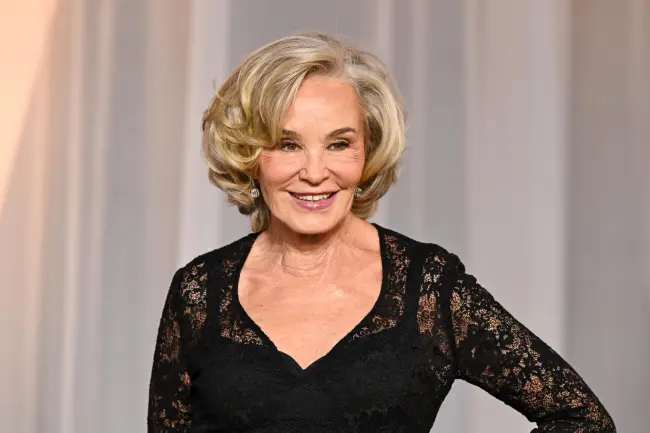
Of all of the awards she’s won — two Oscars, three Emmys, one Tony, and five Golden Globes, among others — Jessica Lange says it’s the Tony Award for A Long Day’s Journey Into Night that’s a highlight for her.
“I’m proud of them all — the fact that your work is recognized on some level is always a wonderful affirmation of what you’ve done,” she tells Gold Derby. But that was the first time she’d ever been nominated for her work on the stage, and so it resonated for her. “The fact that this performance was embraced — especially for a part that means more to me than anything I’ve done in my 50 years of doing this — brought me enormous happiness.” Long Day’s Journey, which is currently in theaters, will be released on digital platforms on December 4.

Yet the role she says she’s most often recognized for today, across her 50-year career, is American Horror Story. “I did those seasons 12 or 15 years ago, and I didn’t realize they were still playing continuously,” she says. “Kids who were probably five when I was shooting those episodes are watching them now.”
Lange is now reprising her role in the Season 13 of American Horror Story, but looks back fondly on those first seasons of the FX series. “You embraced the insanity of it all,” she says. “The characters were larger than life — Gothic, baroque, and really well-written. Sometimes you just had to embrace the craziness and go with it. That was the charm of it and what made the work interesting. You were never limited; you could use your imagination and go anywhere with it.”
But every once in a while, there’s someone who stops her for one of her films. “It’s always surprising who approaches me on the street and says, ‘I just want you to know, I saw Frances when I was 20, and it changed my life,'” she says.
Here, Lange takes Gold Derby through some of her favorite roles of her celebrated, award-winning career.

Frances (1982)
Lange had been shooting The Postman Always Rings Twice, directed by Bob Rafelson and starring Jack Nicholson, and unbeknownst to her, the film’s editor, Graham Clifford, was developing a script about Frances Farmer’s life. When it was greenlit at 20th Century Fox, Clifford wanted her to play the part.
“I love those kinds of parts because you go somewhere inside yourself that you would never normally explore — but it’s all there,” she says. “That’s the great thing about being human: everything is there; you just have to tap into it.”
Lange credits Kim Stanley, who played her mother, with helping her prepare for the role with weeks of improvisation with an acting coach before principal photography began. “It was fascinating work, and I think it made an enormous difference,” she says. “Working with Kim Stanley was one of the great gifts of my 50 years in this business.” Lange learned from her “rawness and absolute honesty — there wasn’t a false moment in anything she did. And her commitment to every moment was beyond 100%.”
Lange recalls filming a scene where she was downstairs in the living room, listening to Stanley’s footsteps scuffling in her slippers upstairs. “Kim came in on her day off to make those sounds offstage for me,” says Lange. “She didn’t have to work that day; she came in so I could hear her. Who does that? That’s Kim.”
Farmer would be the first of many real people that Lange would play over the course of her career, including Patsy Cline, Edith Beale, and Joan Crawford. “You feel a commitment to get as close to who they were as possible,” she says. She dove into research, including watching home movies of her which she found enormously helpful. “I could watch how she moved and how she was in the world — not performing or appearing in a film,” she says. “Seeing her in her natural state, vulnerable and young, opened something for me.”
Lange was nominated for an Oscar for best actress for her work in the film; that same year, she also nominated for best supporting actress for Tootsie. “That year, it was like, ‘Whoa, something just exploded,” she says. “Nothing could prepare you for that.”

Tootsie (1982)
“I almost didn’t do Tootsie,” recalls Lange with a laugh. “I turned it down a couple of times.”
But director Sydney Pollack convinced her that she should follow up her dramatic role in Frances with a comedy, and she’s forever grateful. “Thank God I did, because the film itself has become a classic,” she says. “Comedy was something I didn’t understand. Sydney was an extraordinary director and a tremendous guiding force through the project. And Dustin, too.”
Lange says she learned “how important it is to have a director who knows what he’s doing and what he wants — and knows how to get the actor to give it to him.”
The film’s critical and commercial success surprised her, she says. “I loved working with Sydney and Dustin, but I had no idea it was going to be as good as it was.”
She won the Oscar that night (her co-star Teri Garr was nominated as well, as was Stanley for Frances), but says she remembers little about that night — “back then, you did your own makeup and hair,” she says. “Valentino lent me a dress, I think, but it wasn’t the fashion production it is now.”
But as for whether the win changed the course of her career, she says it’s hard for her to judge. “The next film I did was 180 degrees in the other direction,” she says. Inspired by an article she read in the Los Angeles Times about the 1980s crisis of families losing their farms, she pitched Touchstone on the idea that would become the movie Country. “I didn’t have a screenwriter, an outline, or anything,” she says. “It was exciting and very dear to me because of what was going on in our country.” The role would earn her yet another Oscar nomination.

Sweet Dreams (1985)
Lange continued her arc of embodying real people by starring as country singer Patsy Cline in Sweet Dreams opposite Ed Harris. “I hadn’t been a great country-western fan, so I didn’t know her whole story or catalog of songs,” she admits. “But the script was wonderful, and I loved the idea of working with the great Karel Reisz. Then we got Ed Harris to play Charlie, we went to Nashville to shoot, and I got to pretend that was my voice.”
Given that Cline had an operatic range, Lange says she always knew she’d be lip-syncing. “I have a range of about three notes, so there was never any question I’d do my own singing,” she says with a laugh.
“I’d rehearse for days, going into [producer] Owen Bradley’s studio and having him turn Patsy’s volume up as high as it could go,” she recalls. “Then I’d sing full voice, but no one could hear me. The idea that her voice was moving through me was extraordinary.”
Lange did her usual research to prepare, watching footage of Cline’s television appearances and listening to her music. “She had an exuberance that was contagious,” she says. “She had energy, drive, forbearance, and perseverance.” But she also credits director Karel Reisz with helpful advice: “I remember he compared her to a champagne bottle with the cork popping out,” she says. “That image made me think, ‘Yes, she has that kind of explosive exuberance and energy.’ That’s just off the top of my head. I’m sure he gave me more profound direction than that.”
That was also the first time she worked with Ed Harris, with whom she would later reunite on A Long Day’s Journey Into Night. “He’s unexpected and raw in the moment — thrilling to work with,” she says. “I love working with actors like that, where you don’t know what they’re going to do.” She remembers going to the first screening, and watching a scene with him at the end. “He’s talking about how you don’t know what it’s like to rub up against somebody dangerous, and he does this thing where he twirls around,” she says. “And I thought, ‘F–k. He just stole the movie!”

Blue Sky (1994)
Lange reunited with Tommy Lee Jones for Blue Sky (after what she calls a “very ill-fated PBS version of Cat on a Hot Tin Roof“) for this film about a military scientist married to a woman he described as “crazy as a house rat.”
“We found a way of being together that worked perfectly for Blue Sky,” she says. “Tommy Lee is one of the most honest, raw, completely present actors you could ever wish to work with.”
As in Frances, Lange’s character went to emotional extremes, which is what made her sign on for the role. “More than anything, I’m drawn to troubled characters with deep trauma, who are somewhat mad,” she says. “They let you explore places in yourself you wouldn’t normally delve into. Everything is there somewhere, and I’ve always found playing those characters thrilling.”
Lange recalls fondly the experience of being directed by Tony Richardson, who stood behind the camera, next to the cinematographer. “Tony had a stretch of space next to the camera. They’d sometimes put tape down so people knew not to step into it; that was Tony’s space,” she says. “He’d pace like a great, exotic bird. You were aware of him watching you, and the exchange of energy was wonderful and thrilling.” She laments that loss of energy once video playback was invented, and directors disappeared into video village.
The film sat on a shelf for several years before it was released because the studio, Orion, went bankrupt, but when it was finally released, it earned Lange the Oscar for Best Actress. “It was a wonderful culmination of a difficult stretch,” she says.

Grey Gardens (2009)
“I was getting disillusioned and disappointed with the process and with acting,” says Lange, who says she was going through a stretch of about 10 years of not doing “exciting work.”
Then along came the HBO movie Grey Gardens, and “suddenly it brought something back,” she says. “It made me excited about being an actor again.”
Lange stars alongside Drew Barrymore as Edith Ewing “Big Edie” Bouvier Beale and Edie “Little Edie” Bouvier Beale, the eccentric aunt and cousin of Jackie Kennedy, who were members of high society but retreated into mutually dependent, reclusive lives amid disrepair and decay.
“The scenes that interested me most were the ones we re-created from the Maysles brothers’ film [the 1975 documentary about them],” she says. “I was enamored with this crazy woman doing ‘Tea for Two’ in bed with that hat on. As an actor, to get a chance to do something like that — God, it doesn’t get any better.”
Lange says she studied the Maysles brothers’ film “like it was the Bible.” “I listened to Edith’s voice every morning in my trailer; it informed the day’s work,” she says. “My vocal coach asked if I wanted to do anything differently. I said, ‘I want to do it beat for beat, exactly as she did it.’ You couldn’t improve on it in a thousand years; it’s so perfect. … If there was one thing that helped me drop into the character, it was her voice.”
The house had been somewhat restored by the time they were filming there, but being there also helped her get into character. “I’ve come to believe that the past is still present in many places — this idea of morphic resonance, that something from the past remains,” she says. “You could feel it in that house as you moved around, even though it had been completely restored and was a lovely home. In the garden, beyond the walled garden, you could feel something from the past.”
The film earned 17 Emmy nominations and won six, including lead actress for Lange.

Long Day’s Journey Into Night (2026)
“I first played her 25 years ago. If I could play her 25 years from now, I would,” she says. “Over the years, I’ve found how much I truly, deeply love her.”
Lange has played Mary Tyrone three times: twice on Broadway, including the role that won her the Tony, and now again in a feature. She’s called it the greatest role she’s ever played.
She says playing Mary onscreen at age 77 is even more meaningful.
“As an actor, you bring your life experiences to every part you play,” she says. “In 25 years, there’s been a lot more loss and many more human experiences that you’ve lived through and can use with a character. And doing two long stage productions — seven or eight times a week, week after week, month after month — means something lives inside you.
“When we came to do the film, everything was still there. You go about your life, but when you come back to it, everything is still there. It resides somewhere inside you, in the marrow of your bones. You’re also bringing a deeper life experience to the part because of what you’ve lived through.”
But the film has had a bumpy road to the screen, struggling to find financing and distribution. Production shut down at various points as producers scrambled to get the money — yet the core cast, including Ed Harris, Colin Morgan, and Ben Foster, remained committed. “It’s been a testament to everyone’s perseverance,” says Lange. “As the saying goes, ‘Perseverance furthers.'”
Now that the film is being screened at festivals (it recently played at the SCAD Savannah Film Festival), Lange hopes that audiences can find a message in it. “I think we achieved something important with this film,” says Lange. “It’s a story about family, and I think anyone can find something in it that they recognize… It’s the human experience of family: the ties, the love, the guilt, the blame, the hurt.”
