
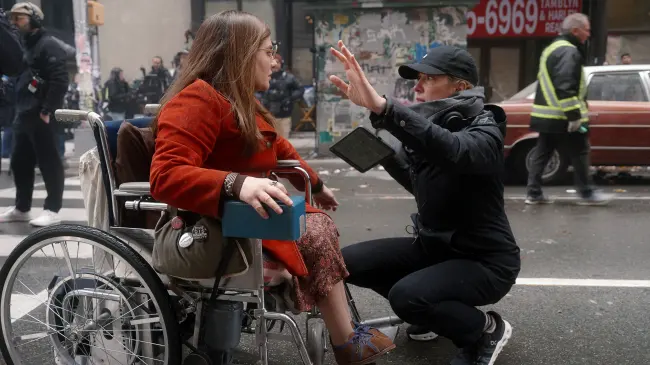
There’s a moment in director Siân Heder’s “Being Heumann” where famed disability rights activist Judy Heumann, played by Ruth Madeley, is told that her actions could inspire people. “Inspire people to do something?” she asks? “Or to just be inspired?”
It’s something Heder herself wanted to avoid when telling the story of Heumann and the 504 sit-ins of 1977 that opened the door for the eventual passage of the Americans With Disabilities Act. The director of the Best Picture-winning CODA wasn’t interested in telling a story where a perfect disabled character inspires people with little more than hope and a smile. She wanted to preserve the contradictions of Heumann that made her, and her activism, compelling.

Audiences don’t admire Judy simply because of what she accomplished. And in Madeley’s hands — along with the help of Heder and Rebekah Taussig’s script — Being Heumann asks them to spend time with a woman who could be difficult, impatient, sexual, funny, angry, and occasionally inconsiderate.
“Judy had every reason to be angry and full of rage,” Heder tells Gold Derby about the film, which opens in theaters on Nov. 6 ahead of its streaming premiere on Apple TV on Nov. 13. “She had lived a lifetime of being excluded, being discriminated against… and she took that rage and turned it into action, and that was something so compelling to me about Judy as a character.”
It’s something that, historically, has been anathema with depictions of disabled women onscreen. Disabled women in movies — the few that exist anyway — have often been gracious and meek, like the Blind Flower Girl in Charlie Chaplin’s City Lights from 1931, or Elizabeth Hartman’s character in 1965’s A Patch of Blue. But to do that stereotype would be disingenuous to who Heumann was.
“Judy balked at this idea that disabled women had to be gracious all the time, and sweet all the time, and get along and smile at people in order to get what they want,” Heder says. “When she went to college, [she had to] be in the hallway smiling at strangers, hoping one of them would help her up the two stairs to the restroom. But there was a point in her life where she decided she was too tired to take care of other people, and that led to a very specific energy that was often really jarring and intimidating.”
For Heder and Taussig, the idea with Being Heumann was simple: to push against the expectations that a disabled woman, or any disabled protagonist, might be likable in order to lead.

Heumann handpicked Heder to direct her life story based on the success of CODA, and the two spent significant time together prior to the activist’s death in 2023. “There were times where I was working with her where I was like, ‘I’m not working for you — I’m working with you,'” Heder says.
Speaking with Heumann’s friends, the filmmaker learned that her subject had a habit of wheeling away to take a phone call mid-conversation, leaving them waiting for her to come back. That behavior often left Heumann’s collaborator, Kitty Cone (played by Madeline Delp in the film), to act as “the cleanup crew” for those who felt offended by those interruptions. “Judy would offend everyone in the room, and then Kitty would come in and do a round of apologies to smooth it all over,” says Heder. “When you’re writing about someone, sometimes you’re doing therapy on them that they haven’t done on themselves.”
Heder and Taussig didn’t want to excuse Heumann’s behavior, nor were they interested in removing the circumstances that explained it. Audiences are instead left to understand both the activist and the person. Heder’s previous experience on CODA helped her approach Being Heumann with a greater appreciation for the specificity in disability, and the danger of making one character responsible for representing an entire community.
“I remember a conversation where a deaf woman said to me, ‘This mother [in CODA] is a narcissist. Are you saying that all deaf women are narcissists?’ I’m like, ‘No. I’m saying that this particular mother in this particular instance was a narcissist, and yes, she also happens to be deaf.'”

That conversation taught Heder a valuable lesson: “One story cannot heal decades of zero representation, and it can’t hold it all,” she remarks. On top of that, Heumann was a real person, so there was an additional opportunity to present her as she was — a tough woman who was also a wheelchair user.
Much of this distinction came through bringing Taussig, who uses a wheelchair, on as co-screenwriter. “Rebekah was amazing with story, and as we started talking she was really great at thinking about character and arc,” Heder says. “I was like, ‘You could write me essays that are inside these characters’ heads. You could write me a poem about what it’s like to have this experience.’ It would be bringing your voice and your perspective into the mix.”
Taussig’s perspective came in most handy most when depicting the romantic and sexual relationship between Heumann and fellow activist, Jim (Jon Beavers). “I remember talking about that a lot with her,” Heder says. “Rebekah’s perspective gave me permission to say that caregiving can be sexy. That it can be hot to be transferred in that way, definitely with the humor and with finding the nuance of these characters. It was such an essential collaboration for me.”
More than anything, Heder understood that directing Being Heumann meant taking responsibility for a story that was deeply meaningful to the disability-rights community. “Judy chose me,” she remarks. “I felt that I really wanted to honor that because she saw something in me that told her that I was the right person to tell this story.”
