
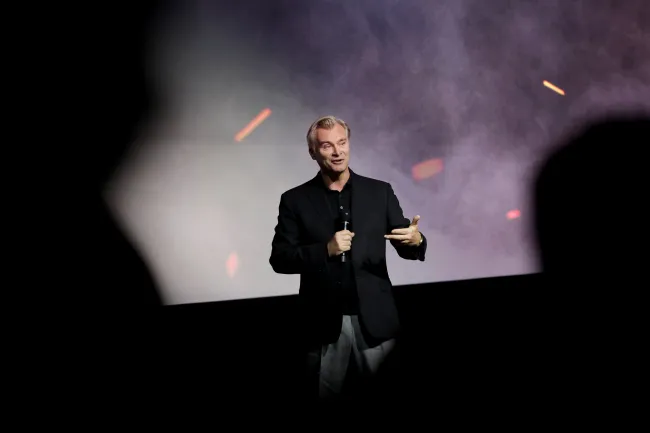
Like a certain Ozian wizard, The Odyssey producer-director-writer Christopher Nolan sheepishly stepped out from behind the curtain at the Steven Spielberg Theater on the Universal lot Tuesday, ready to reveal his magic act to an auditorium full of Hollywood guild members, awards voters, and press.
“Gosh, I don’t know why I’m nervous, because the film has been out for months,” the filmmaker began once the ovation died down. “I have absolutely mastered the art of talking a lot and revealing absolutely nothing,” Nolan continued. “So I’m told I need to get out of the way and let some of the crew members… talk to you, have a voice, share some of their experiences.


“For me, that’s always difficult, because you want an audience coming to the film fresh. You want them to lose themselves in the world. So talking about how you’ve done things always feels a bit counterintuitive to me.”
Nolan let most of the talking be done by his cast and crew, first in the world premiere screening of “Behind the Scenes of The Odyssey,” a document of the epic shoot that will be featured on next week’s digital release , and then in a post-screen panel moderated by the film’s star, Matt Damon.
“When I look at what everybody working on this film did, and what they were able to pull off and the challenges they were able to rise to, I came away even more impressed,” Nolan said. “It wasn’t like letting the air out of the balloon. It was fun to revisit a lot of these things.”

Damon opened by calling the panelists among the most talented artists he had worked with, then asked producer Emma Thomas, who also happens to be Nolan’s wife, how the team approached what he described as “six different movies in one.”
“You said, ‘We’ve made each one of these movies before. We were on the water in Dunkirk, we were on the mountain in Batman Begins and Interstellar,'” Damon recounted. “You walked me through the movies and said, “We’ve just never done them all at once.”
“The more movies [Chris and I] make, the more I certainly am able to trust the process,” she replied. “In prep, he’s demanding the absolute impossible. … But then once you start shooting, he becomes incredibly pragmatic.”

Thomas said that she and Nolan have found that too much prep can impede the creative process and bog down the shoot, so he prefers a more accelerated schedule — a challenge that many of the department heads called both exhilarating and exhausting.
“You need to ground mythology”
The conversation turned to world-building, a task that fell largely to production designer Ruth De Jong, who scouted locations across Europe and Africa to find ideal spaces for Nolan’s vision. “Chris starts earlier with his production designer. We did the same on Oppenheimer. The beautiful thing about working with Chris, in the world of Christopher Nolan, is that we use our imagination for a while. We marinate,” she explained. “We’re not really interested in reusing imagery we’ve seen in books or films. We pull from the real world, from what inspires us, and we find that on the trail. Chris and I often stumbled into these locations.”
“Was it completely impractical to shoot in Italy? It was. But was it larger than life, on a scale and scope and range you’ve never seen before.”

Although she had to create the looks for a cast of thousands, costume designer Ellen Mirojnick said one look unlocked everything else. “With the scope and bigness of the world, the characters, the time, and the places, we broke it down. We had to break it down. It’s a crazy thing: with the specificity you need for Ithaca, the Spartans, Troy, and so on, you have to do it methodically. But the most important thing was finding Odysseus first.

“The costume language we created for Odysseus — the simplicity of his form, the clean line — indicated strength and power, but also allowed us to deconstruct it and live the exhausted journey he goes on. You can feel the consequences of that journey in the clothes.”
Hair department head Gloria Casny and makeup department head Luisa Abel discussed research and the lived-in details — from cultural differences in hair to dirt, dust and mud — that helped make the world cohesive.
“We had a conversation about how you need to ground mythology. That really resonated with me. To make the story look real and believable, we had to figure out how to do that practically for every sequence,” said Abel. “Every single person had dirt on them.” Casny and Abel assembled a small army of local stylists in each country to handle more than 7,000 extras.
“The rock-star instrument of ancient Greece”
When Damon got to composer Ludwig Göransson, the star revealed a conversation he had on set with Nolan. “Most composers come in after, and you were there really before anybody. All Chris would say to me, because I was very interested in what you were working on, was ‘Gongs.’ I was like, ‘What do you mean, gongs?’ And he said, ‘Well, I told him he can’t do anything that’s ever been done before, so he’s
got to use instruments nobody’s heard for thousands of years, or heard in this context.’
That set the composer around the world looking for period-appropriate instruments to incorporate into his score. “I’d heard gongs before — in the theme song from Mortal Kombat, in sound baths, and in traditional Japanese music — but I’d never sat with them for a long time and tried to figure out how I could use them and write songs on those instruments.” He searched for someone who could play the lyre, which Nolan wanted to echo Odysseus’ bow string, and the aulos, a double flute that Göransson says was “the rock-star instrument of ancient Greece” but ultimately was banned for being “too pagan.”

A key part of the soundscape, according to supervising sound editor Craig Henighan, was sourcing authentic sounds that he hadn’t used before. “I want fresh sounds, fresh ingredients,” he said, to “support story, support narrative, and bring it forward.”
Production sound mixer Willie Burton, who was embedded with the cast on set, recalled recording aboard the ship. “The captain made a statement. He said that everything on this ship will kill you,” Burton said, prompting laughs. But there was limited room on deck for Burton and his equipment. “Chris looked at me and said, ‘Well, Willie, there is a hold.’ So, the hold. The ship’s crew personnel said no one ever survives the hold.” But Burton and his gear survived soaking storms to capture the sound so well that Damon noted that he didn’t need to loop one line of dialogue. But there was an unintended consequence of being belowdecks. “I became the clerk because everything is stored there. So I’m working in the hold and trying to do sound, but every time they wanted snacks, I was giving out snacks at
the same time.”
Surviving the Cyclops
Visual effects supervisor Andrew Jackson and special effects supervisor Scott R. Fisher said the pacing of the shoot forced them to work together to shift rapidly from one demanding sequence to the next, especially with Nolan wanting to do as much as possible in-camera. Jackson said he knew from the get-go that one sequence would be a huge challenge to execute practically.
“The Cyclops sequence was probably the one I immediately recognized I’d need to focus on the hardest at the beginning. Chris and I agreed that having something there to occupy that space was important,” he said. “When the actors, camera, and everyone are around, they need something there.”

“With all the Cyclops stuff and the set pieces, we went through everything together constantly, discovering the process as we went,” noted editor Jennifer Lame, who worked alongside production. “They were doing it in a way that I really don’t think had ever been done before, so we were
learning how to do it during the shoot.”
“The next thing is what it always is,” said Fisher. “You have Morocco and all the stuff going on there, and you’ve barely got that done when the next thing is Cyclops. We’re sending teams and guys ahead to prep and work, supervisors from all over the world to help us out … because every one of these things is like a movie in itself.”
“Replicating the gods, myths, monsters, and legends”
Casting director John Papsidera had to fill out a cast with dozens of speaking roles, each played by performers who could feel authentic to Nolan’s world. But he focused his initial efforts on the key roles. “One thing we talked about very early on was replicating the idea of gods, myths, monsters, and legends with the stars of our time.

“That’s not a suck-up to Matt, but it’s about finding major movie stars and the superstars of our own era to fill this world, so they weren’t mere mortals on screen. They were larger than life. That gave me a basis to start with the bigger roles and work quickly.”
“Guiding everybody, inspiring everybody”
Nolan in his introduction and Thomas in her closing remarks shifted the focus to Damon — not just as Odysseus, but as a presence on set who helped carry the production.
“I couldn’t imagine making this film with anybody else,” Nolan said. “For me, I think he gave me the performance of a lifetime, in my opinion. I just know that the heart and center of the film — the person we go on the journey with as we’re watching the movie — is Odysseus, and that’s Matt’s incredible performance. It’s not unlike how it was to make the film.
“He was there, guiding everybody, inspiring everybody with his example. Really, genuinely a leader.”

Thomas directly addressed Damon. “There’s no world in which we could have made this movie without you on just a pure practical level,” she said, adding, “You were on set on time with the best attitude every morning. You brought everyone along with you.”
Damon aw-shucked it, and gave final props to the entire cast and crew: “It felt like we were on an expedition together.”
