
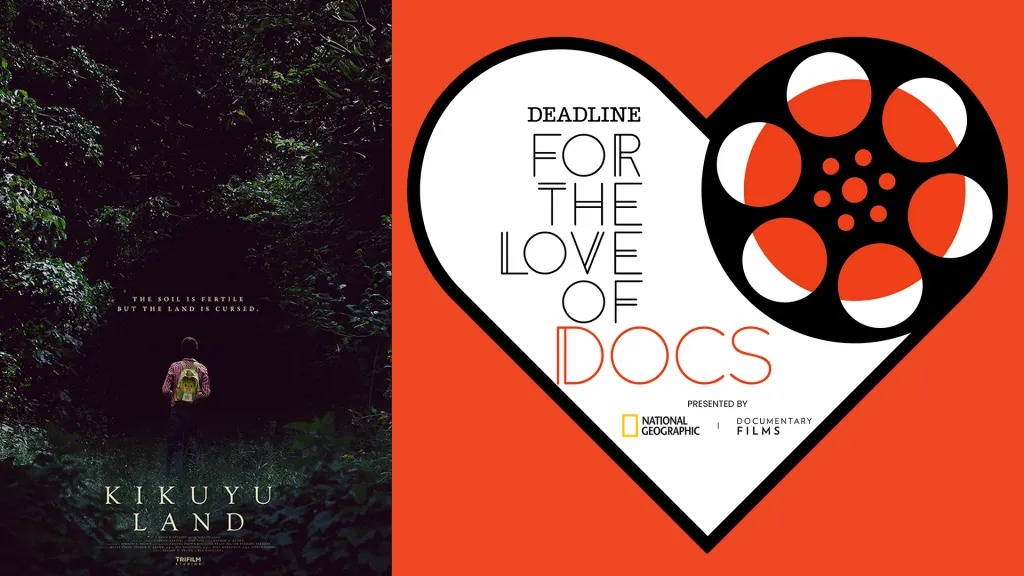
The legacy of colonialism comes at a tremendous cost to protagonists of the award-winning documentary Kikuyu Land.
Take Mr. Mungai, for instance, whose family owned land in Kenya’s tea highlands that was seized by the British when they ruled the country. The land’s value today: in the billions of dollars. The film, which screened Tuesday evening as part of Deadline’s For the Love of Docs virtual event series, follows Mr. Mungai as he pursues a legal battle to get back the magnificent acreage, now controlled by multinational corporations.
“I met Mr. Mungai through [Joseph] NJenga… our other producer,” Bea Wangondu, who directed Kikuyu Land with Andrew H. Brown, explained during a discussion after the screening. “And the introduction was, ‘Come and meet this man who’s got all this paperwork, evidence [of land theft] that he’s collected over eight years,’ and we just clicked. He’s an amazing human being. He’s now a dad to me… We are very close.”
L-R Stephanie Owens, Joseph Njenga, N’ganga Mungai, Moses Bwayo, Bea Wangondu, Andrew H. Brown, Mike Morrisroe, Tracy Rector and Nyokabi Kariuki attend the ‘Kikuyu Land’ premiere at Sundance.
Arturo Holmes/Getty Images
Wangondu, herself a Kenyan native, continued, “What we are experiencing currently in Kenya with land is trauma — trauma from people who’ve lost land for almost a hundred years and have never gotten it back and don’t know if they actually will get it back. And that trauma is being passed on from one generation to the other, as is poverty.”
The film, winner of Best Documentary Feature at Mountainfilm in Colorado and Best Social Justice Feature at Jackson Doc Fest in Tennessee, also explores the plight of tea harvesters who face alarming exploitation as they work the land. The conditions may remind American viewers of what they’ve read about slavery in the antebellum era.

Mr. Mungai in ‘Kikuyu Land’
Courtesy of Trifilm Studios/Photo by Andrew H. Brown
“It felt straight out of the textbook of the American South, but instead of cotton fields, it obviously was tea,” Brown observed. “The shocking thing is in Kenya, it’s so in your face. Obviously in the U.S., we still have systems of oppression and systems that certainly don’t serve all communities here. In Kenya, it was more shocking, though, to see it so clear. And it became very obvious why these corporations create big walls and won’t let you get anywhere near the walls, near the gates, certainly not with a camera because they’re nothing short of a plantation when you get inside.”
Kikuyu Land also tracks the story of Stephen, the 13-year-old son of a tea worker. He’s full of hopes, dreams, and intellectual curiosity.
‘Kikuyu Land’
Courtesy Trifilm Studios/The Bea Company
“If he was in any other community, we’d slap the label on quickly of a prodigy,” Brown said. “The very first question that I had from him… he was asking about the SD card in my camera and saying, ‘How does electricity burn my image and my sound of my voice on this little card?’ And I was like, ‘Stephen, I just hit this red button when I see something that I like, and then when it’s over, I hit it [again]. I don’t know.’”
But Stephen’s fate wouldn’t be to develop his talents but to support his family as a tea worker.
“The older he got, you kind of saw that innocence get stripped away slowly, bit by bit,” Brown noted. “And that’s really what became of his story. When we first met him, a kid that had a shine in his [eyes] and huge dreams, huge, huge dreams. And you just saw that glimmer in his eye kind of fade as he started realizing what path the system had already carved out for him.”
Wangondu’s path was also to prove a difficult one. The journalist and filmmaker ran afoul of powerful interests by pursuing the documentary. And members of her family didn’t take kindly to her investigation into her grandfather, whom she concluded to have been complicit with the British in their colonial project. She has had to take up residence in the United States.
“My whole life is built in Nairobi. I run a production company. I hire people. We have projects that are ongoing,” she said, attempting to describe her sense of anguish. “That’s one side. And then for me, being out here, brand new place, I have to completely do a whole mind shift into what life is like here. I never imagined. I’m not the kid that wanted to go out of Kenya… It’s difficult to process still and what becomes of me and what now, it’s just hard. Honestly, I still don’t have the words to describe how difficult this has been for me. And also, then being separated from my family, we’ve never been separated ever, and that’s painful.”
Kikuyu Land opens in New York City on Friday, at the DCTV Firehouse (the film team will be on hand for Q&As on Friday, Saturday, and Sunday).
Watch the full conversation with Wangondu and Brown in the video above.
For The Love of Docs is produced with the long-time support of National Geographic Documentary Films. Films are presented free of charge to the audience and to the filmmakers. The series continues with weekly screenings, followed by conversations with filmmakers through December 1. Join us next week for To Hold a Mountain, directed by Biljana Tutorov and Petar Glomazić, the Sundance award-winning film about a woman’s fight to protect her daughter and to prevent beautiful Montenegrin mountain pastures from being taken over by the military. To RSVP for the screening, click here.
