
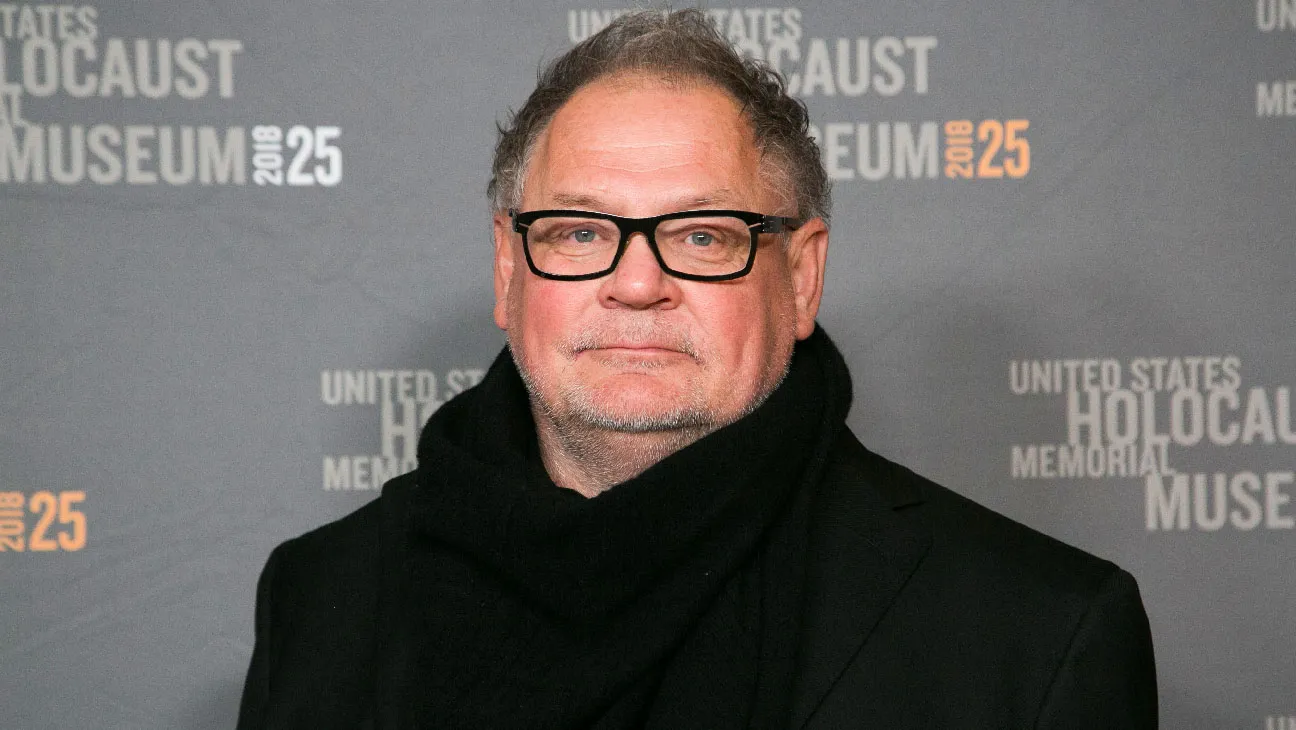
Like pretty much every great cinematographer, Janusz Kamiński is Polish. As much as any single artist of his generation, he has also taught Hollywood how to see.
Kamiński, winner of THR‘s 2026 Visionary Award for excellence in cinematography, presented at the Camerimage festival on Saturday, grew up in Ziębice, a small town where, as he remembers it, the world was gray. “Although we didn’t feel it was bleak, it was bleak,” Kamiński says. “No billboards. No advertisements. The streets were dark. People dressed in darker tones.” In winter, the houses were heated with coal, and the smoke from every chimney stayed in the air. “The air had this thickness in it, like a fog, because of the coal particles.”
But there was a lot of longing in that gray. “Poland is a very lyrical country, to some degree,” he says. “There’s that melancholy, that certain wish for something else.” Theater troupes passed through, and the local cinema promised a world beyond the town. “We were exposed to work that we didn’t experience in real life, but we wanted to experience,” Kamiński says. “The primary reason I left home is because of the theater and movies, and a life of color.”
Kamiński left Poland as a political refugee in 1981, dreaming of American movies. He spoke no English. Landing in Chicago, he spent two years learning the language and then enrolled part-time at Columbia College. In an introductory filmmaking class, he found himself in a group of five. “We had to each pick: One would be the writer, one the actor, one the director, one the producer, and one the cinematographer,” he recalls. “We literally picked straws. I got cinematography. I was 22.”
It was love at first sight. “I found out I really enjoyed creating images. It was just fascinating for me to see the flickering image on 16 mm black and white,” he says. “Just that mystery: Will it be in focus? Will it be properly exposed? Will it have a story?” A professor told him he was good at it and should keep going. “This is not a sad story, but it was the first time anyone every told me I was good at something,” says Kamiński. “In Poland, when I grew up, nobody’s parents said that kind of thing. It was: You have food, you eat, you’re good.”
All his classmates at Columbia wanted to direct, so Kamiński shot their movies. He loaded a station wagon with equipment every weekend and made student films, and picked up commercial work as a camera assistant, an electrician and a grip. One commercial spot a month would pay $250. “My rent was $280, so I was doing good,” he says. “I had a job, and for an immigrant, it’s essential that we support ourselves, because there was no mommy, no daddy, no cousins.”
‘Schindler’s List’
Universal/Courtesy Everett Collection
In the early days, The Hollywood Reporter came to his aid. Back then, in the back of the magazine, THR ran lists of movies going into production, including location shoots. “That’s how I got my first jobs, through The Hollywood Reporter,” says Kamiński. “I’d look at that films listed and I wouldn’t call on a Tom Cruise movie, but if it was something like Bambis from Hell, I’d call the producer up and say ‘Hi, my name is Janusz Kamiński. I’m a cinematographer. Would you like to look at my work? I got my first two features from that.”
Kaminski knew Chicago would not get him to Hollywood. “Most of the movies that would originate in California would come into Chicago and use secondary crew members,” he says. “I don’t want to be secondary.” His girlfriend filled out an application to the American Film Institute, and he was accepted. “That was 1986/87. I moved to California, another place I’d never been to. I had no car.” He rented a place within walking distance of campus.
A classmate’s husband, a cinematographer, was shooting a movie for Roger Corman and needed a key grip. Kamiński took the job. “Meanwhile, the gaffer quit. So I said, I like lighting. Let me. So I became the gaffer.” He kept shooting second unit and small independent films while he finished school.
The real break came through his demo reel. A friend of a friend was Diane Keaton’s assistant. “He shows my demo reel, my student film demo reel, to Diane Keaton and, suddenly, I have a job shooting for Diane Keaton.” The film was Wildflower, a period TV movie with Patricia Arquette and Beau Bridges. Steven Spielberg saw it and offered Kaminski another TV gig, Class of ‘61, a pilot Spielberg was producing. The show, about West Point cadets on the eve of the Civil War, didn’t get picked up. But Spielberg liked what he saw. When the pilot wrapped, the two men met. “He says, ‘I’d like you to film my next movie. I’m doing a black and white movie called Schindler’s List. Would you be interested?’”
Spielberg first went off to do Jurassic Park. “It took him eight to nine months to finish editing,” Kamiński recalls. “All that time I knew I had a job coming with Steven Spielberg. But nobody believed me. Only when I shot the movie, it became reality.”
With Spielberg, Kamiński went home to Poland. The film he shot there, full of the gray light and smoky streets he had grown up in, changed how Hollywood shot history. He says the two of them barely discussed the visual style beforehand. “We knew it would be shot in Poland and be black-and-white, but we didn’t have a deep, in-depth conversation about how we’re going to make this movie,” he recalls. “We just wanted to strip away anything that would take us away from the story, so there was no crane, no dolly and no Steadicam. I brought in the idea of using handheld.”

‘Saving Private Ryan‘
Photofest
Schindler’s List won Kamiński his first Oscar for Best Cinematography. Saving Private Ryan won him a second. The script for that film, he points out, contained one sentence about the landing at Normandy: “Now the troops land at Normandy. That’s it. So as a cinematographer, you have to create the language that corresponds to the story, to the emotions, to the sets and the locations.” What he and Spielberg came up with, all handheld, drained of color and chaotic, rewrote the language of the war movie.
Shooting Julian Schnabel’s The Diving Bell and the Butterfly, Kamiński took another phenomenal visual approach to depict the story of a man with locked-in syndrome, only able to see the world through a single functioning eye. In the film, won Camerimage’s Golden Frog honor in 2007, the lens shifts sharply in and out of focus, blurring most of the field of vision while some details pop with intense clarity.
“The script, and the book it was based on, are great,” says Kamiński, but provided little guidance. “The whole description is: ‘The hero returns from darkness, from being unconscious for the last two weeks, and starts seeing the world through one eye.’ That’s it.”
Samantha Morton and Tom Cruise in ‘Minority Report’
20th Century Fox Film Corp. All rights reserved./Courtesy Everett Collection
Despite certain aesthetic preferences — ”I do like strong light, particularly backlight, I like characters in half-light, going into and out of the shadows. I like smoke” he says — Kamiński does not have a signature look. His approach is film follows function. Cold blues and metallic shadows to evoke the tech-dystopia of Minority Report. Retro pastels and smooth tracking shots to make the 60s swing in Catch Me If You Can. Grainy, handheld shots of muted oranges and browns in Munich to give the story the feel of a 1970s conspiracy thriller.
The Kamiński/Spielberg collaboration, which now stretches over 30 years and more than 20 films, has to count as one of the most significant artistic collaborations in American cinema history. His work with Kamiński marks the second phase of Spielberg’s career, as the director moved from glossy, classical Hollywood imagery, sharp lights and bright colors, to a grittier, more naturalistic style, appropriate to the more mature, morally-ambivalent stories he wanted to tell.
Kamiński does not claim credit for the director’s evolution. “Steven was not ready to do Schindler’s List until he was ready,” he says. “He was moving that way and I entered his life at the right point where he was able to accept the aesthetics I gave him and embrace them. I think what he saw in me was someone new with a new point of view, someone who wasn’t biased by Hollywood, with a fresh approach. He saw me as a partner. And I saw him as a partner.”
‘Disclosure Day‘
Universal Pictures and Amblin Entertainment
The partnership continues on Spielberg’s latest, Disclosure Day, which has Kamiński working in a different register. “As I’m getting older, things are becoming more simplistic,” he says. “I want to go slightly more reserved, relaxed.”
For the film, a sci-fi thriller about aliens, but set in the present day, he says he aimed for “something more naturalistic, more contemporary.” In one scene, in a safe house, a gray, very direct light comes through the window, slightly green, with a little flare in the background. “It’s got austerity in the images,” Kamiński says, “and that comes from growing up in Poland, with the images from my childhood.”
Next up is another collaboration with Spielberg, on an untitled Western, the director’s first, which Spielberg hopes to shoot next year. Kamiński is already imagining the landscape, drawing, as always, from the world he grew up in.
“We used to go to this region in the Sudeten Mountains, where it was just beautiful, rolling hills, looked like parts of Montana,” he says. “The lay of the land, the snow on the ground, the fog.” All these elements exist in America too, he acknowledges, but “those who shoot American movies tend to come from somewhere else, and we see these same things differently. That’s why there’s room in this profession for men and women from different countries who bring different aesthetics to American movies.”
