
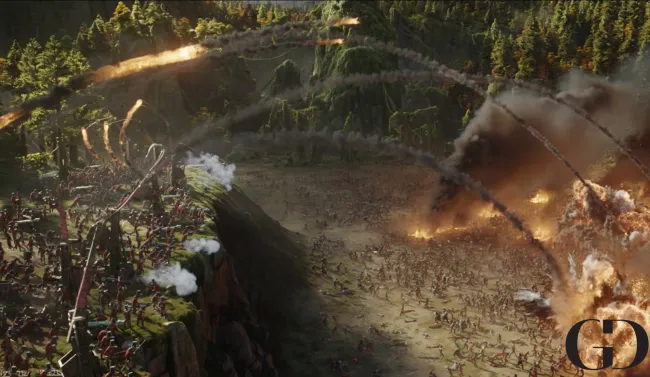
The third-act showdown in Laika‘s fantasy adventure Wildwood is unlike anything ever created for stop-motion. Titled the Battle for the Plinth, the epic 12-minute graphic sequence (earning the film’s PG-13 rating) contains 411 shots and 3,000 puppet combatants (humans, coyotes, birds, and other beasts) clashing on a woodland Oregon battlefield comprising five massive, practical sets. It’s almost like watching The Lord of the Rings in miniature.
However, to pull off director Travis Knight’s enormous live-action vision required considerable digital VFX assistance. “I feel like we managed to create something really significant with [the battle],” Laika VFX supervisor Steve Emerson tells Gold Derby. In fact, he pulled out his original notes for the first meeting about Plinth back in 2020: “‘The battle is going to be the single most ambitious sequence in the history of animation. It will be a combination of spectacle, scale, and ferocious violence. We have never seen anything like this in the history of [stop-motion].’ I walked out of that meeting with such a feeling of inspiration and fear. Like, how the heck are we going to do this?”


The battle, which takes place on different slopes of the hilly field, contains intricate choreography, lighting (supervised by legendary cinematographer Caleb Deschanel), puppet interaction, and lots of explosive excitement and damage. But there was tremendous problem-solving for every single shot. “What was really important to Travis was that the battle played out as this series of escalations,” Emerson explains. “There’s tension that builds, faceoffs, charging upon each other, a mid-battlefield collision, sneak attack. It’s about grit, handheld camera work, and an element of spectacle to it. But we had the advantage of lining up cameras, blocking shots, rehearsing shots, and then shooting the animation.”
Yet Laika needed to expand beyond the limits of its own in-house VFX capabilities. So who better than Wētā FX for this Portlandized version of The Lord of the Rings? “We were very much trying to find our way through this massive film, and they brought so much to the table in terms of straight up artistic talent and resources,” Emerson says. “They’re coming off three Avatar movies and they have such a hot rod of pipeline and technology that getting to work with them was like jumping into a sports car and hitting the coast with the top down.”

Laika partnered with Wētā FX to help extend practical sets (at a 1/5 scale compared to a live-action set), populate crowded shots, and integrate digital elements such as fire, smoke, wind, dust, and explosions to complete the scenes. They also created digi-doubles indistinguishable from real hero puppets.
In addition, the legendary New Zealand studio used lighting as a creative storytelling tool, artfully recreating the lighting designed by legendary cinematographer Caleb Deschanel while integrating supporting digital elements and ensuring each shot was individually lit for its cinematographic needs, rather than purely for continuity.
“So Laika thought it would be a good idea to take a portion of the show [the battle] and find a partner to help visualize,” Wētā VFX supervisor Guy Williams says to Gold Derby. “I got told that they might want a little help on the Laika side of things for a supervisor to give some advice and tips, and I ended up staying for six months, it was that great.”
On the surface, Williams finds CG and stop-motion polar opposites, but when fused together the way Knight has guided Laika, you achieve a hyper-real spectacle.
“CG is the pinnacle of what reality is, it’s a simulation of reality,” Williams adds. “Puppetry is taking reality and trying to bend it into storytelling. Laika’s been pushing for a long time to figure out how to get better armatures; their puppets have breathing controls, which is just insane. All this complex stuff stuffed into a one-foot-tall puppet. They’ve been working to perfect their craft.”
Williams met the team at Laika in Portland and started understanding their process along with the scope and challenges of the production. Two of his colleagues, Dan Macarin and Sabine Laimer, took supervisory roles from the Wētā side.
“It took a while to digest and understand how intricate everything that they do is,” Macarin tells Gold Derby. “To translate that into something digital so that the film has a really smooth flow and never feels like it’s going from a stop-motion world to a digital world. At first, we thought we had to dial our stuff back to stop-motion, but then when we went through it with them, and they showed us everything they were able to do with the fingers on the puppets and these very small controls, and how all the faces ran at 24 frames per second, that enabled our translation process to work a lot smoother in that we weren’t very restricted at all.”

Wētā also needed to adapt their physics-based simulation toolset to Laika’s stop-motion style, enabling the creation of explosions, fire, and other effects that were believable within the world of Wildwood. This includes its award-winning fire and combustion toolset, Kora, which was used to make a library of more than 70 simulations covering different scales and behaviors (everything from weapon fire to flowing oil spill fires).
“We had to redesign and almost simplify fire to a certain extent to be able to shape every single shot,” Macarin adds. “We wanted to make sure there was larger fires almost silhouetting characters at times, and that the speed of the fire not only gave us a sense of depth, slowing down as it went further back in depth, but also that the depth carried through and didn’t hide too much of the battle sequence or hide characters.”
The highlight was when 13-year-old Prue (Peyton Elizabeth Lee) frantically runs through a maze of fire and smoke to catch up with villainous Alexandra (Carey Mulligan), who has kidnapped Prue’s infant brother Mac. The biggest visual reference was the Imax documentary short “Fires of Kuwait.”

“The first time I saw this in storyboard format, I was trying to wrap my head around it,” Emerson recalls. “I know where we’re looking at and what the puppets are doing, and there are a lot of scribbles around it. I’m thinking to myself: That’s going to be a really busy image. How are we going to keep the eye where we want it. As soon as Travis said we’re doing a hellscape, it entirely clicked because then I knew we could use shadow, light, smoke, atmospherics, ash, and color, like fire. What we’re doing in visual effects is making an incredible, epic moment and connecting with her emotionally.”
“It had to feel like a different place, and there was a lot of beautiful artwork done by the Laika art directors,” Williams suggests. “You spent the entire movie establishing that Wildwood is this gorgeous, verdant, green expanse. But because of the actions of a selfish individual [Alexandra], we devolve a portion of this into Dante’s Inferno.
“There’s a lot of effort that goes into it,” Williams continues, “but to get the shot across the line, there’s a big oner where Prue runs past a bear who’s mowing down people with a tree trunk. We have all these beautiful vignettes of action, but we want to find the bear and all these coyotes. And you don’t have shots to set it up so that the audience knows what’s about to happen and where to look.
“It’s like an onion, there are layers to this,” adds Williams. “You leverage smoke, fire, silhouette, light to create the better read on the bear and all the coyotes that you want to mow down. But at the same time, you can’t lose sight of the fact that Prue is smack in the middle of the hellscape. So it’s this incredible balance of trying to put more vignettes of soldiers fighting back there so that, beyond the bear, through the haze, you can start to make out hundreds of more people so that you understand that it’s this amazingly complex battlefield that we’re in.”

Yet there’s also a critical moment for Prue’s nerdy friend Curtis (Jacob Tremblay) where he witnesses the death of an animal comrade. “We had a great directive from Guy, which was that people should be crying,” Macarin explains. “If you do not get emotionally attached to Curtis in this moment, we are going to miss a tremendous opportunity. And so the speed and flow around Curtis had to make sure that you never lost sight of his emotional tie to this character during that close-up.”
For Emerson, there were many struggles and moments where he didn’t know how or when they would finish the battle. “What I would say to Travis is what keeps me going is that when we finish this, it will be the greatest thing that I’ve ever done,” he recalls. “And then Travis looked at me and he said, ‘Steve, we’re just getting started,’ so that fueled me for a couple more years. And then finally seeing it with an audience for the first time, it was absolutely worth all the sacrifice.”
