
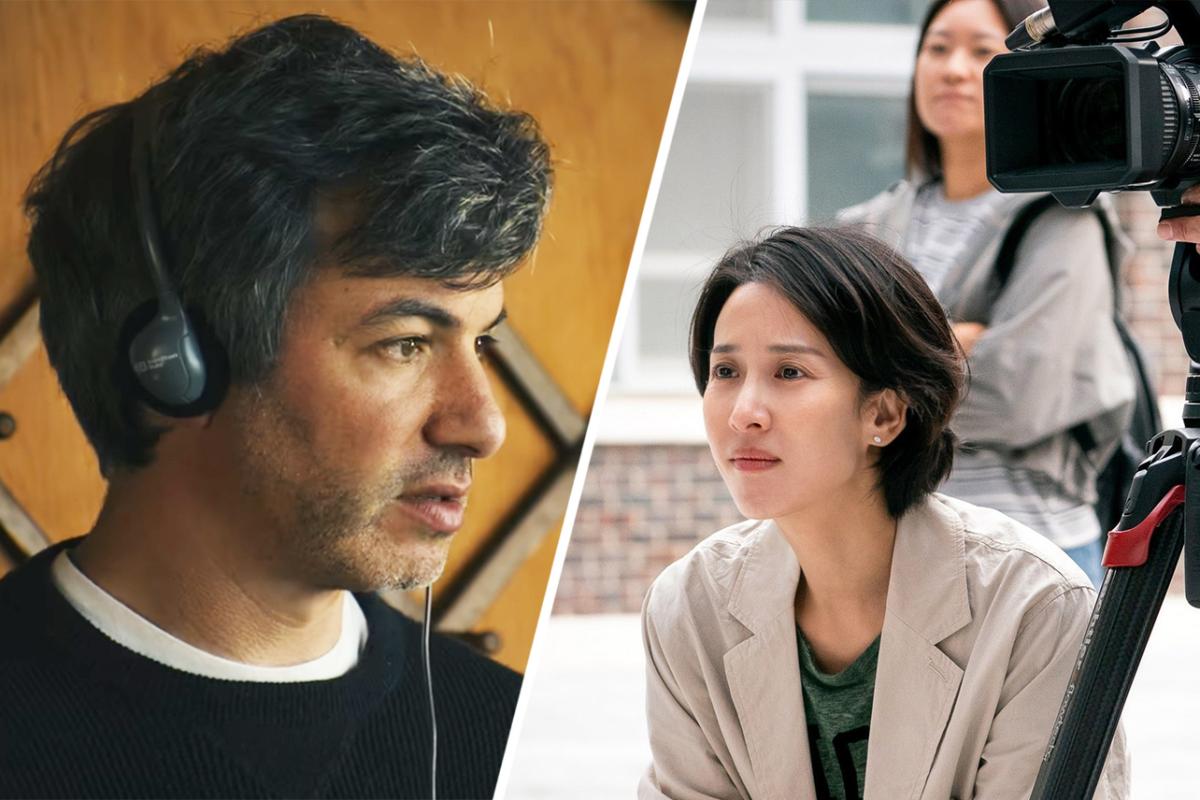
Possible Love—the new drama from acclaimed Korean filmmaker Lee Chang-dong that released on Netflix today—would make a good double feature with You Can See Everything. (It would, admittedly, be a long double feature; both movies clock in at nearly three hours.) Both films pose same question: How much can viewers really trust documentary filmmakers to capture the truth?
Possible Love, which was directed by Lee and written by Lee and Oh Jung-mi, is not a documentary, but it is a fictional drama about a documentary. Award-winning actress Jeon Do-yeon stars as a a working-class woman named Mi-ok who befriends a documentary filmmaker Lee Ye-ji (who, just like Possible Love‘s actual director, is referred to by everyone as “Director Lee”). Mi-ok agrees to participate in a doc about the laid-off workers of an auto plant.
Mi-ok’s husband, Ho-seok (Sul Kyung-gu) was one of those workers, let go after a long, vicious union strike that ended with authorities beating—and even killing—the workers. Ho-seok survived, for now. (Many of his fellow laid-off workers took their own lives.) He’s grown increasingly despondent with his family and reliant on alcohol to cope with his trauma. Director Lee thinks he’s the perfect subject to be the star of her documentary.

Mi-ok, lonely and starved for connection, is flattered by Director Lee’s interest in their lives. She’s equally charmed by Director Lee’s wealthy, handsome husband, Sang-woo (Zo In-sung). It’s a little awkward that whenever Mi-ok shares anything meaningful with her new friend, Director Lee whips out her camera and asks her to repeat it on film. But Lee and Sang-woo’s lives are so glamorous, and they are generous with their wealth. Fancy dinners lead to an invitation to stay at Sang-woo’s luxurious second home on the coast for the weekend. Mi-ok agrees, eager. Ho-seok follows, reluctant.
Mi-ok and Director Lee’s friendship seems genuine, at times. They get drunk together, laugh together, playfully call each other “bitch” together. Yes, the affection is calculated on Director Lee’s end. She frankly informs her husband that she is trying to love Mi-ok and Ho-seok, for the sake of her documentary. But does that make the love less real?

It does, in fact. By the end of the movie, both Mi-ok and the audience realize that Director Lee is lying to Mi-ok (and perhaps also to herself) by pretending they are equals. It doesn’t matter if Director Lee got her designer shirt on sale. It doesn’t matter if she has a story about looking at the moon as a young girl, just like Mi-ok. At the end of the day, Director Lee does not treat like Mi-ok like an equal. When Director Lee wants to share something personal, she turns the camera off. When Mi-ok has a breakdown in the woods, hopeless and vulnerable, Director Lee hides in the trees, filming her. That’s not authentic friendship—it’s manipulation.
You Can See Everything, by contrast—the buzzy new documentary from directors Lance Oppenheim and Nathan Fielder—asks viewers to question Nathan Fielder as a documentarian not for manipulating his subject with his affection, but for being manipulated by his subject because of his affection. Without getting too deep into spoilers, the film intentionally leaves audiences wondering if Fielder caught feelings (whether platonic or romantic) for his subject, the convicted tech CEO fraudster Elizabeth Holmes.
Whether that actually happened or not, many were left so unsettled by the implication that the documentary filmmaker might not be 100 percent trustworthy, that they took to the internet to question whether the film was actually a documentary.
Both Possible Love and You Can See Everything call into question the idea that documentary filmmakers are unbiased third parties who deliver the whole truth (and nothing by the truth) in their films. In fact, documentary filmmakers are artists like any other, with their own worldviews, ambitions, goals, and bias.
Yes, You Can See Everything is a documentary—but it’s a documentary that deliberately prompts viewers to question its own narrative. Possible Love, meanwhile, is a drama that invites viewers to consider the real, human lives of the sob stories you see exploited by documentary cameras. Neither film is attacking the legitimacy of documentaries; both films are challenging viewers to dig deeper with the genre.
A documentary filmmaker may promise authentic love to subject. A documentary subject may promise authentic transparency to a filmmaker. It’s everyone’s job to question that authenticity.
