
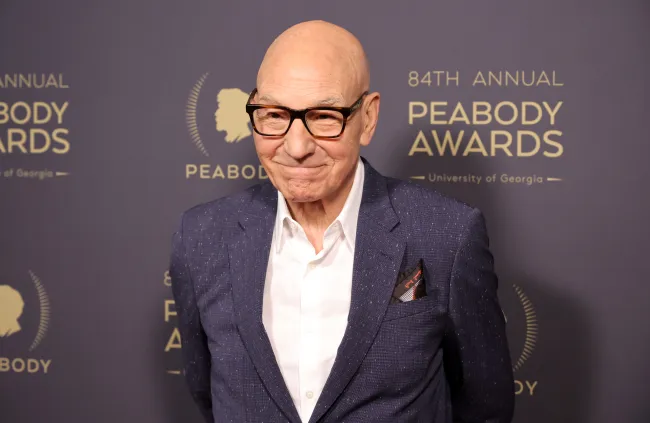
A legend of the stage and screen, Patrick Stewart died at his home in Los Angeles on Oct. 28. He was 86.
“He has been held in the warm embrace of family and friends, surrounded by live music, prayer, tears, laughter and the kind of profound emotion that only he could inspire after a lifetime of devotion to us all,” longtime rep Kelly Bush Novak said in a statement. “We will forever cherish the peaceful ease and reflection on his face, an enduring reminder of his invincible grace.”
After working as a member of the Royal Shakespeare Company beginning in the mid-1960s, Stewart found fame later in life than most, becoming one of the most recognizable actors on television as the lead of Star Trek: The Next Generation. As Captain Jean-Luc Picard, Stewart led the revitalization of the classic sci-fi series — first on TV and then in film, before returning to the role in 2020 for a three-season run on Star Trek: Picard. His profile rose to even greater stature in the early 2000s with the X-Men films.

But Stewart’s work on those essential pop culture titles only made up part of a career that was as vast and varied as it was extraordinary.
Royal Shakespeare Company
Stewart joined the famed group of Shakespearean players in 1966 and stayed with the company until 1982. While with the Royal Shakespeare company, he made his Broadway debut in the 1970 production of A Midsummer Night’s Dream and received his first Olivier nomination in 1979 for his role in The Merchant of Venice.
Tinker Tailor Soldier Spy (1979)
One of Stewart’s earlier television roles placed him opposite Alec Guinness as John le Carré’s legendary spy, George Smiley, in Tinker Tailor Soldier Spy. Stewart played the part of Soviet spymaster Karla and reprised the performance in the follow-up, Smiley’s People.
Jean-Luc Picard
But it wasn’t until 1987 that Stewart’s profile went intergalactic with Gene Roddenberry’s return to interplanetary travel, Star Trek: The Next Generation. Stewart captained the Enterprise through seven seasons of television and four feature films. He would eventually return to the part in 2020 for the sequel series Star Trek: Picard, which ran for three seasons on Paramount+.
Peter and the Wolf (1996)
Outside of his two Olivier Awards, the only other major honor Stewart received from an awards body was his Grammy for Best Spoken Word Album for Children in 1996. He won the award for his rendition of Prokofiev’s Peter and the Wolf.
A Christmas Carol (1999)
By the time Stewart played Ebenezer Scrooge in the made-for-TV film based on Charles Dickens’s Christmas classic, he already had plenty of experience with the miser. Stewart began performing a one-man stage adaptation of the novella in 1988, eventually transferring it to Broadway. The part would lead to his first Grammy nomination and another Olivier nod.
Professor Charles Xavier
Whatever corners of nerd culture were unconquered by Stewart after his run as Captain Jean-Luc Picard eventually fell to him during his years as the leader of the X-Men, Professor Charles Xavier. Beginning in 2000, Stewart lent his hairless pate and gravitas to the comic book adaptations that would create the template for the wave of superhero movies to come. Stewart appeared in eight movies as the character and will make it nine with this December’s Avengers: Doomsday.
The Lion in Winter (2003)
Stewart earned both Emmy and Golden Globe nominations for his portrayal of Henry II, opposite Glenn Close in this made-for-TV adaptation of James Goldman’s play.
Extras (2004)
Tapping into a sense of humor often missing from his more popular work, Stewart played a perverted version of himself on Ricky Gervais’s entertainment satire, Extras.
Green Room (2015)
Stewart played way against type in Jeremy Saulnier’s container thriller when he took on the role of Darcy, a white supremacist gang leader who coldly dispatches members of a punk band after they witness a murder inside his club.
