
Sci-fi may very well be one the hardest genres on television to keep alive. Its shows can be pricey to make, challenging to market, and quick to get canceled, so the ones that reach 100 episodes deserve some recognition.
That kind of staying power is incredibly rare in this era of television, which is why it became the basis for this list, where every sci-fi show reached over 100 episodes. The longevity rule disqualified some of the genre’s most treasured titles. “Firefly” gained a cult following and even led to a film, but was canceled way too soon, with only 14 episodes produced. “Battlestar Galactica,” for its part, spawned a prequel and a pair of companion films, but wrapped with fewer than 80 episodes. Even “Fringe,” it turns out, bowed out with its 100th episode.
But none of the shows that ultimately made the cut simply coasted. Several outlasted cast turnover, network changes, even a cancellation. Among them: a 1959 anthology that influenced countless shows in the years that followed, a sequel series set aboard a starship that expanded a franchise, and a procedural that turned out to be about A.I. Here are 10 shows that earned every minute of their airtime.
The Twilight Zone
Before “The Twilight Zone,” Rod Serling spent the late ’50s seeing his scripts get reworked beyond recognition by executives wary of alienating customers, including his 1956 teleplay inspired by the murder of Emmett Till that aired without its original Southern setting. His genius solution: Stop writing about the present and start writing about the unknown.
“The Twilight Zone” premiered in 1959 with Serling as its host, narrator, and the writer of many of its 156 episodes. Each one features a new story brought to life by a new cast, from a nervous flier who spots a gremlin on the plane’s wing to a bookworm who gets all the time in the world to read. Many up-and-coming movie stars appeared on “The Twilight Zone,” including Robert Redford, Robert Duvall, and Burt Reynolds.
What makes the show so powerful, and even haunting, is just how much it accomplishes in any one episode. Its twists made the series famous, but they arguably land because the episodes offer believable characters trapped in scenarios that resonate, whether it’s a man desperate for solitude or neighbors on a street who come to distrust one another. The show also snuck in social commentary that sponsors overlooked, dressing up real-world fears as alien invaders, for example, and largely getting away with it. Sharp viewers, however, knew better. “The Twilight Zone” ultimately won three Emmys, including two for outstanding writing achievement in drama, and many shows, including “Black Mirror,” have aired in its shadow.
Doctor Who
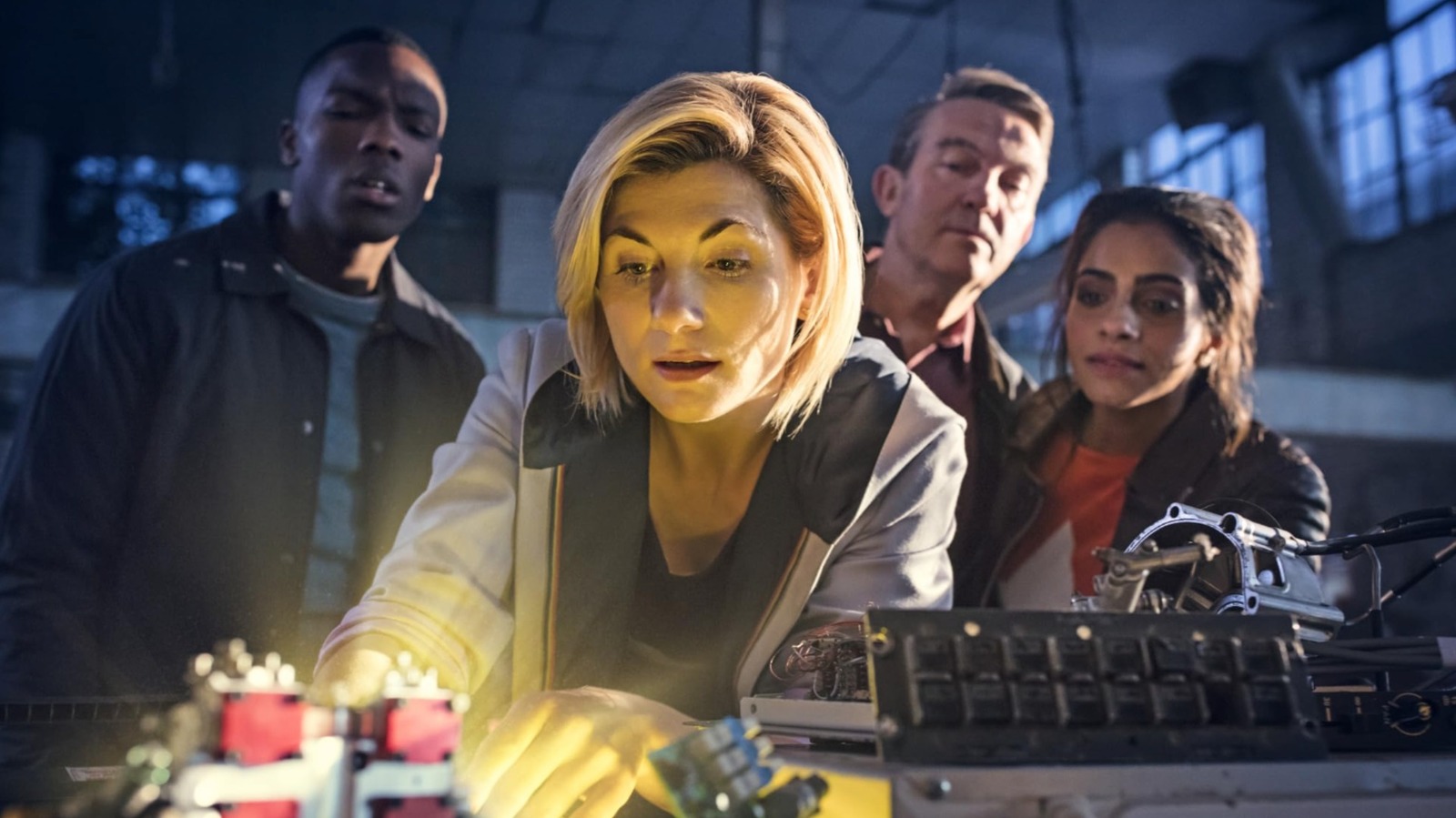
One of sci-fi’s most acclaimed shows became known for a twist born from necessity. When the health of “Doctor Who” star William Hartnell failed, the producers decided their alien hero could cheat death, inhabiting a new body. Patrick Troughton took over in 1966, and “Doctor Who” has pulled the same trick many times over, allowing a range of actors to play the character, from Tom Baker and Sylvester McCoy to David Tennant and Jodie Whittaker.
The show’s format, thankfully, is as creative as its casting. The TARDIS, a time machine disguised as a ’60s London police box, can land anywhere. This means that while one week brings a historical drama, the next features a war with the Daleks, the pepper-pot killers who’ve hounded the Doctor since the show’s second serial. The series was shelved in 1989 after 26 seasons, and apart from a 1996 TV movie, that seemed to be that. Then, showrunner Russell T Davies revived “Doctor Who” in 2005, this time with Christopher Eccleston as the lead.
With more than 800 episodes across both eras, the show holds the Guinness World Records title for most prolific science-fiction TV series. It is currently on hiatus, however. Ncuti Gatwa’s Doctor regenerated into a version played by Billie Piper in May 2025, a twist yet to be explained. This June, a Christmas special was canceled and Davies exited the series. Still, if “Doctor Who” has proven anything, it’s that the Doctor is nothing if not persistent.
Star Trek: The Next Generation
Creator Gene Roddenberry could have simply reunited the cast of “The Original Series” for “Star Trek: The Next Generation.” Instead, his ambitious follow-up jumped nearly a century ahead to a new U.S.S. Enterprise. And this starship’s captain, Jean-Luc Picard (Patrick Stewart), is a far cry from James T. Kirk. If Kirk is cavalier, Picard prefers diplomatic discussions.
Decades later, the reputation of “The Next Generation” rests on episodes like “The Best of Both Worlds,” the two-parter in which the Borg assimilate Picard and turn him against the Federation. It was the franchise’s first real season-ending cliffhanger. The show also manages indelible storytelling moments in episodes largely set outside the Enterprise, whether it is a glimpse at Picard’s slow, painful recovery from his Borg experience in “Family,” or when Picard experiences decades of the life of a deceased scientist in “The Inner Light.”
“The Next Generation” ultimately ran seven seasons, four more than “The Original Series,” and won 17 Emmys, all in craft categories like outstanding individual achievement in special visual effects. But just as important, it proved Star Trek could still explore strange new worlds and civilizations without Kirk and Spock — and prosper. In doing so, it opened a door, with later years bringing spin-offs and films, from “Deep Space Nine” and “Voyager,” to “Discovery,” “Lower Decks,” and “Strange New Worlds.”
The X-Files
With “The X-Files,” creator Chris Carter turned an unglamorous basement office at FBI headquarters into one of the most iconic settings in ’90s television. Agent Fox Mulder (David Duchovny), a true believer in extraterrestrials, was paired with Dana Scully (Gillian Anderson), a medical doctor. No two cases are alike, and many defy the laws of nature. One episode features a mutant who can squeeze through vents, while another follows an insurance salesman who foresees others’ deaths.
While the cases are remarkable, Carter’s real ingenuity lies in the show’s structure. “The X-Files” deftly moves between “monster of the week” episodes and installments that advance the show’s longer-running alien conspiracy, and in doing so, offers a structural blueprint that arguably influenced later shows like “Fringe” and “Supernatural.” The series is also unafraid to experiment, with episodes like Season 5’s “The Post-Modern Prometheus” shot in black and white, or Season 7’s “X-Cops,” which was filmed like a tongue-in-cheek reality show.
“The X-Files” finished its original run in 2002, but that wasn’t the last time viewers heard from Mulder and Scully. Duchovny and Anderson reprised their roles for Season 10 in 2016 and Season 11 in 2018, bringing the show’s total number of episodes to 218. The awards recognition came too, with five Golden Globes including best television series – drama. The show ultimately spawned two films and the spin-off “The Lone Gunmen,” with Hulu ordering a reboot series from Ryan Coogler to star Danielle Deadwyler and Himesh Patel.
Babylon 5
While many early-’90s dramas wiped the slate clean every week, J. Michael Straczynski approached “Babylon 5” with an ambitious, long-term plan. “The idea of saying, ‘This is gonna go five years, and we’re done’ and ‘It’s gonna have the structure of a novel,’ and that we’re building toward a conclusion really had never been done,” Straczynski told GamesRadar.
“Babylon 5” is set in the year 2258, aboard a five-mile-long space station, a neutral port where humans and several alien powers haggle, scheme, and try to head off another war. The early episodes play like a far-flung political drama, with the show’s best characters being its ambassadors: Londo Mollari (Peter Jurasik), a fading aristocrat who makes a devil’s bargain to restore his empire’s glory, and G’Kar (Andreas Katsulas), his bitter rival, whom suffering turns into something close to a prophet.
Straczynski ultimately became the dominant voice, with many of the show’s episodes bearing his writing credit. The show, which managed 111 episodes, also survived a revolving door of cast members. Michael O’Hare, who played Commander Jeffrey Sinclair, exited after the first season and was replaced by Bruce Boxleitner, who portrayed Captain John Sheridan. Meanwhile, Claudia Christian, who played Susan Ivanova, left before the final season. Still, “Babylon 5” won two Hugo Awards for best dramatic presentation, and it remains one of the few ’90s sci-fi shows that still hold up today.
The Outer Limits
While “The Outer Limits” on ABC eked out just 49 episodes, the 1995 revival had much better luck, lasting 152 episodes across seven seasons, first on Showtime, and then later on the Sci-Fi Channel.
Every episode introduced a new nightmare played out by a new cast, with each scenario often based around a scientific breakthrough or alien encounter that, unsurprisingly, went terribly. Scientists who experimented in areas like cloning, time travel, or the human mind usually paid a steep price, and a closing narration spelled out the episode’s difficult moral lesson. Still, Showtime didn’t make the series’ writers sand down the rough edges. The bodies piled up, the clothes came off, and those endings could get downright bleak.
The revival never forgot its roots. Leonard Nimoy, for instance, played a reporter in the original’s 1964 “I, Robot,” and when the revival remade that episode in 1995, he returned as the attorney defending the robot on trial, with his son, Adam Nimoy, directing. Amanda Plummer’s appearance even won an Emmy for outstanding guest actress for a drama series in 1996. The revival never achieved the same kind of cultural footprint as “The Twilight Zone,” or even of the ’60s original it very clearly drew from, but its willingness to push scientific breakthroughs toward realms of unsettling moral consequences made the revival more than simply a nostalgia exercise.
Stargate SG-1
Roland Emmerich’s film “Stargate” sends its heroes through an ancient alien gate to a desert planet. But “Stargate SG-1,” which proved one of the rare television dramas better than the movies that inspired them, discovered that gate could go almost anywhere. About a year later, the Air Force now is now running a secret program out of Cheyenne Mountain. A team led by Col. Jack O’Neill (Richard Dean Anderson, replacing Kurt Russell) steps through the gate each week to explore alien worlds and fight parasitic beings known as the Goa’uld. The archaeologist from the film, Daniel Jackson (played now by Michael Shanks), also returns, joined by astrophysicist Samantha Carter (Amanda Tapping) and the alien defector Teal’c (Christopher Judge).
Where the movie plays it straight, “Stargate SG-1” handles everything with more of a wink. Anderson portrays O’Neill as a smart-alecky leader who loathes mission briefings, and the show is also rife with banter. Viewers largely stuck around despite a change of networks, even a late-run overhaul that swapped Anderson out for Ben Browder and added Claudia Black. And by the time it ended in 2007, the show had aired 213 episodes across 10 seasons.
“Stargate SG-1” led to spin-offs, including “Stargate Atlantis,” which ran for five seasons and 99 episodes, and “Stargate Universe,” which just lasted two seasons. The animated series “Stargate Infinity” and web prequel “Stargate Origins” followed, along with two direct-to-DVD movies, “The Ark of Truth” and “Continuum,” that extended the original series’ run.
Futurama
“Futurama” is a show that has lived several lives. Creators Matt Groening and David X. Cohen’s follow-up to “The Simpsons” began on Fox in 1999 with Philip J. Fry (Billy West), a wayward pizza boy cryogenically frozen as 1999 ends, only to thaw out in the year 3000. He ends up working for a very distant relative’s delivery company alongside Leela (Katey Sagal), the cyclops captain he pines for, and Bender (John DiMaggio), a robot who runs on beer and petty theft.
Fox stopped making “Futurama” in 2003, but after four direct-to-DVD movies, Comedy Central revived it through 2013, and Hulu revived it in 2023. The show’s writers have been a highly educated bunch, with deep academic backgrounds in math and computer science. Writer Ken Keeler, it turns out, even proved a brand-new theorem to make the body-swapping plot of the Season 6 episode, “The Prisoner of Benda,” work. The show went on to win six Emmys, including two for outstanding animated program and another two for outstanding voice-over performance for Maurice LaMarche. And to its credit, Season 4’s “Jurassic Bark,” which centers on Fry’s dog, is still the episode most likely to make viewers’ eyes water.
Season 14 finished in September, bringing the total to at least 180 episodes, and while another season hasn’t been ordered yet, three specials are due, starting in 2027. Groening seems unbothered by the show’s latest hiatus. “Well, we’ve come to an end many times before,” he told Variety.
Lost
“Lost” begins with a beach full of plane fragments and wraps with a finale reuniting the castaways in a church. But in between, the ABC drama, which premiered in 2004, turned a plane crash into one of the most debated shows on television. On a Pacific island, survivors of Oceanic Flight 815, led by a spinal surgeon (Matthew Fox) and a fugitive (Evangeline Lilly), start encountering problems, some of which defy rational explanation: a polar bear, black smoke that kills, a group of “Others” who got there first. Flashbacks reveal the castaways’ lives before the crash, and one of the show’s best twists is turning them into flash-forwards and even sideways jumps.
The show’s sci-fi elements were introduced slowly. But by Season 5, the island was skipping through time, and at one point, the survivors were living in the ’70s. That level of storytelling ambition won “Lost” 10 Emmys, including outstanding drama series and two trophies for outstanding supporting actor in a drama series — one for Michael Emerson’s performance of Ben Linus and the other for Terry O’Quinn’s portrayal of John Locke.
Then there’s “The End.” The series finale is divisive, and even the “Lost” creators and ABC had very different ideas about when the show should end. How viewers feel about it depends on whether they were invested for the mysteries or the characters themselves. After 121 episodes, “Lost” returned to its first image: Jack in the bamboo grove, his eyes closing this time rather than opening.
Person of Interest
“Person of Interest” once seemed like the quintessential CBS show with its crime-of-the-week format, but it only got sharper with age. It follows software billionaire Harold Finch (Michael Emerson), who built the government a post-9/11 surveillance system that predicts crimes. The government, it turns out, only really cares about terrorism, so Finch recruits ex-CIA operative John Reese (Jim Caviezel) to stop the ordinary murders also flagged by the Machine. The catch: The Machine only offers Social Security numbers as clues. So, every case begins with Reese trailing someone who may be about to die or about to kill.
Early on, the Machine seemed to be little more than a clever plot device for offering fresh cases. But across five seasons and 103 episodes, it took on a life of its own. It learned, even seemed to grieve. The show’s back half pits it against the rival system Samaritan. Amy Acker’s Root, a hacker who worships the Machine, and Sarah Shahi’s Shaw, who treats it like a coworker, make the show feel like an ensemble.
Creator Jonathan Nolan isn’t claiming “Person of Interest” somehow foresaw a future dealing with the consequences of A.I. “I wouldn’t credit us with any particular gift for prophecy. The pieces of it were right there if you cared to look at them,” he told Semafor. That may be the case. But in 2011, a network drama about A.I. influencing major outcomes looked like science fiction. Now, it’s looking a lot less so.
